A store that sells to US buyers may owe US sales tax, whether or not the company is based in the United States. Sales tax is levied by states (and in some states by localities), collected from the buyer by the seller and passed to the state tax authority. Whether you must collect depends on whether you have nexus, a tax connection, in that state. A physical presence is physical nexus; sales or order counts above a state's threshold create economic nexus, and the threshold differs by state. Shopify can show the risk, calculate tax and produce reports, but it does not register you or file for you. Its managed-tax and automated-filing options are currently closed to most stores.
This is general information, not tax or legal advice. Tax rules and state thresholds change. The state thresholds quoted below carry a check date, and no number is given for a state that was not checked. For a decision that costs real money, confirm with a US certified public accountant (CPA).
What sales tax is and who collects it
Sales tax is a state-level tax (some states add local taxes), computed from factors that include where the order is shipped. The seller charges it at checkout and files it periodically with the state. The syllabus of the US Supreme Court's decision in South Dakota v. Wayfair (decided 2018-06-21) states that sellers are required to collect and remit the tax, and that when they do not, in-state consumers owe a use tax at the same rate. The Court overruled the earlier Quill rule that a business with no physical presence could not be made to collect. South Dakota's law at the time covered sellers delivering more than USD 100,000 of goods or services into the state a year, or making 200 or more separate transactions. After the decision, each state applies its own thresholds.
Shopify's Help Center says economic nexus rules apply to all merchants with customers in the United States, including non-US merchants. A mainland China or Hong Kong entity selling to US buyers therefore has to check each state's rules too.
Nexus: physical and economic
- Physical nexus. An office, store, warehouse or employees in a state. Shopify adds that some states define it more broadly and may include soliciting sales, fulfillment services and holding inventory. Whether stock in a US third-party warehouse creates nexus has to be checked against that state's rules.
- Economic nexus. No physical presence, but your sales into the state (in some states also the number of orders) exceed its threshold.
Where you have no nexus, you are generally not required to collect sales or use tax (Shopify's state reference).
Why thresholds differ by state
Each state legislates for itself, so the threshold, the measuring period and whether order counts matter all vary. The table gives three states' official wording in summary. Do not copy one state's rule to another.
| State | How the threshold is worded | Source and check date |
|---|---|---|
| California | A retailer located outside California with combined sales of tangible personal property for delivery in California above USD 500,000 "in the preceding or current calendar year" must register with CDTFA and collect use tax. Sales by related persons are included | California CDTFA Wayfair page, read 2026-11-03, no update date shown; the rule is operative from 2019-04-01 |
| Texas | A remote seller with total Texas revenue under USD 500,000 in the "preceding twelve calendar months" does not need a permit; above it, a permit is required and collection must begin no later than the first day of the fourth month after the month the amount was exceeded. Revenue is gross revenue from taxable and nontaxable sales of tangible personal property and services, including separately stated handling, transportation and installation fees | Texas Comptroller remote sellers page, read 2026-11-03, no update date shown |
| New York | In the "immediately preceding four sales tax quarters", more than USD 500,000 of gross receipts from tangible personal property delivered into New York and more than 100 sales. The page says both conditions must be met. The quarters are March to May, June to August, September to November, and December to February | New York Department of Taxation and Finance nexus page, updated 2026-07-29, read 2026-11-03 |
The same USD 500,000 figure is measured three ways: a calendar year in California, a rolling 12 months in Texas, and a four-quarter window with an order count in New York. Shopify's state reference gives a sense of the range. Most states list USD 100,000 (some with "or 200 orders"), Alabama and Mississippi list USD 250,000, California and Texas list USD 500,000, and New York lists USD 500,000 and 100 orders. That table is Shopify's own summary and was not checked line by line against each statute, so use it as a starting point and confirm on the state's page.
What Shopify can and cannot do
| It can | It cannot, or be careful |
|---|---|
| Show a tax liability summary at Settings > Taxes and duties > United States. "Action required" means a possible physical or economic nexus. "Monitoring" means that in a state where you have no location, your sales within Shopify have reached at least 80% of the state's threshold | It is not the opinion of a tax authority and does not replace a tax professional. Whether and how much to collect remains your responsibility |
| Calculate and collect sales tax from the states and numbers you enter, and produce tax reports to help you file | It does not register you with a state. You register first, and only then set up collection in Shopify |
| Track thresholds using net sales (sales less refunds, shipping and tax) | Texas measures gross revenue that includes separately stated transportation fees. Where a state's measure differs, Shopify's figure can run low |
| Track thresholds for orders placed in Shopify and for imported orders | It counts only orders that have a shipping address. Sales on other platforms are yours to add. Nexus for local taxes is not tracked |
| Managed sales tax, where Shopify collects and remits for you | Early access only, for selected stores opened after 2026-10-27, based in the United States and using Shopify Payments. Because the store must be US-based, non-US stores cannot use it |
| Automated filing with Shopify Tax | Closed to new enrollment. It files returns for sales through 2026-12-31, after which you file yourself or use a third-party filing service. Shopify's page names Numeral and Zamp as examples; that is not a recommendation |
Order of operations
- Check exposure. Export US sales for the past 12 months by state, including orders from outside Shopify, and compare with each state's threshold. List any inventory, warehouse or staff you have in the US.
- Register. For each state where you must collect, register with that state's tax authority and obtain the sales tax number. Shopify requires registration before you set up collection.
- Configure collection. In Shopify, add each registered state with its number, and set shipping tax where the state's rules need it.
- File. File on the state's schedule, monthly, quarterly or annually. Shopify's reports are your working papers, not the filing itself.
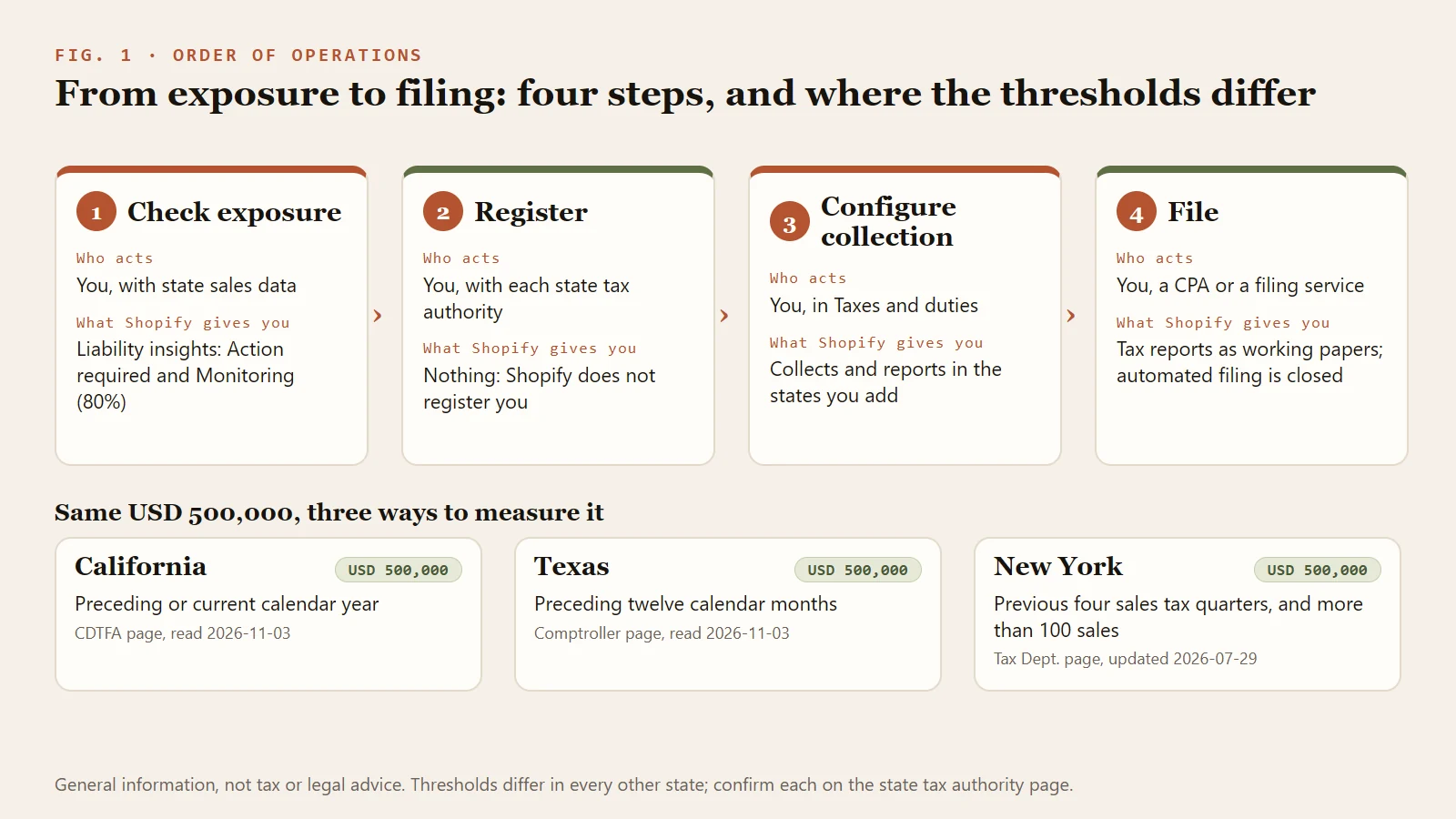
Figure 1: Who does each step, and how three states measure the same USD 500,000.
A hypothetical example for step 1. Say a state's threshold is USD 500,000 and your sales into it over 12 months are USD 410,000. That is 82% of the threshold, above the 80% mark, so Shopify shows Monitoring. If you sell into Texas and pass USD 500,000 in March 2027, collection must begin no later than 1 July 2027, the first day of the fourth month after March, and the permit has to be in place before then. For the tax itself, take an order of USD 80 and an assumed combined rate of 8%: sales tax = 80 × 8% = USD 6.40, and the buyer pays USD 86.40 (whether shipping is taxable varies by state, so shipping is left out). The USD 6.40 is not your revenue. You hold it for the state.
Marketplace facilitator vs your own storefront
| Channel | Who is responsible for the tax | Point to note |
|---|---|---|
| Your own Shopify storefront | You | Where you have nexus, you register, collect and file |
| Orders placed through Shopify's Shop channel | The Shop channel | Shopify says that since 2025-01-01 Shop collects, remits and files tax on orders shipping to or within the US, regardless of your tax settings |
| A marketplace facilitator in California | The facilitator | California says that when the facilitator is registered or required to be registered, it is the retailer responsible for collecting, reporting and paying the tax |
| Texas | Depends on whether you sell only through facilitators | A seller that sells only through a marketplace provider that collects and reports tax does not need a Texas permit |
| New York | You | New York says sales you make through an online marketplace into New York should be included when you test the thresholds |
In the three states checked here, sales made through a marketplace still count toward the threshold. California and Texas do not require a seller whose only sales go through a collecting marketplace to register; New York includes those sales in its test. Other states may differ, so check each one.
When to hire a CPA
These triggers are editorial suggestions, not legal requirements:
- Shopify shows Action required in any state, or Monitoring in a state where you also have sales outside Shopify.
- You hold inventory, use a third-party warehouse or have staff in the US.
- You must register and file in more than two states.
- A state tax authority has written to you.
- You want to assess whether past sales already carry tax due.
You do not need to wait until the amounts are large. The first time you assess exposure and decide which states to register in, one consultation is worth having. Ask the CPA for fees.
Mistakes to avoid
- Turning on collection in Shopify before registering.
- Trusting Shopify's numbers alone and forgetting off-platform orders and each state's own measure.
- Treating sales tax as revenue and spending it.
- Applying one state's threshold to every state.
- Treating the threshold as a one-time check. Recheck as volume grows; the Monitoring status exists for that.
- Not keeping the reports and order detail behind each return you file.
What to read next
For the click-by-click setup, see the deeper member lessons on taxes and duties and US tax and chargebacks; the conclusions here do not depend on them. For choosing a payment route, see Mainland China entity selling on Shopify: how to choose a payment route, and for how refunds and chargebacks are counted, see Refunds vs chargebacks: the difference, thresholds and prevention. Before launch, the launch readiness tool checks policy pages and the checkout path, and Policy Pages To Fix Before Paid Traffic covers the policy side.
Frequently asked questions
My company is in mainland China. Do I owe US sales tax?
Possibly. Shopify says economic nexus rules apply to every merchant with US customers, including non-US merchants. Whether you do depends on whether your sales into each state pass that state's threshold, or whether you have a physical presence in the US.
Are nexus and registration the same thing?
No. Nexus decides whether you have a duty to collect. Registration is your filing with the state's tax authority that gives you the right to collect. Shopify requires you to register first, and only then lets you set up collection in the admin.
Will Shopify file my sales tax automatically?
Generally not. Shopify's Help Center says tax is your responsibility and Shopify does not file for you unless you use its managed option or an already enrolled automated-filing plan. Managed sales tax is currently limited to selected US stores. Automated filing is closed to new enrollment and ends after sales through 2026-12-31.
If a marketplace collects tax, do I still need to register?
It depends on the state and the channel. California says the facilitator is the retailer responsible for collecting. Texas says a seller that sells only through a collecting marketplace needs no Texas permit. New York says marketplace sales count toward its thresholds, and Texas and California count them too; the difference is whether a seller with only marketplace sales must register. Sales through your own storefront still need to be judged by nexus.
Can I look up the thresholds myself?
Yes. Start with Shopify's state tax reference and tax liability pages, then confirm the wording on the state tax authority's own site. Shopify's pages are a summary; the state's page is the authority.
Sources
Last verified: 2026-11-03. All content here is general information and is not tax or legal advice.
- Shopify: understanding tax liability, US tax liability insights, US taxes reference, setting up US taxes
- Shopify: taxes overview, considerations for Shopify Tax, automated filing considerations
- Shopify: managed sales tax, filing after automated filing ends
- South Dakota v. Wayfair, Inc., 585 U.S. 162 (2018), US Government Publishing Office
- California CDTFA: use tax collection requirements after Wayfair, frequently asked questions
- Texas Comptroller: remote sellers, marketplace FAQ
- New York Department of Taxation and Finance: registration requirement for businesses with no physical presence