Cross-Border Compliance and Risk Governance
Turn market entry, privacy consent, EU GPSR/VAT, US tax and disputes, product claims, launch QA, incident response, and quarterly governance into an operating risk system for ecommerce.
Quick Answers
TL;DR: This series is step-based; follow in order and complete each practical lesson.
Q: Should I follow the order?A: Yes, later lessons often depend on earlier concepts.
Independent-store operators who want to practice decisions and actions through complete cases.
Start with lesson one. If joining midway, complete the prior lesson check or record first.
Complete the series checklists, decision records, and next actions so the same operating standard can be reviewed again.
Best for readers willing to complete the exercises and records in order. For one specific concept, open the matching lesson directly.
- Published
- Updated
- Last reviewed
Maintainer: Ranfeng Wei · Established a verifiable publication, modification, and maintenance-review baseline.
Who Should Start Here
Best for Shopify and independent-store operators who want to carry the course checks, decisions, and actions directly into team execution.
Most Critical Lessons
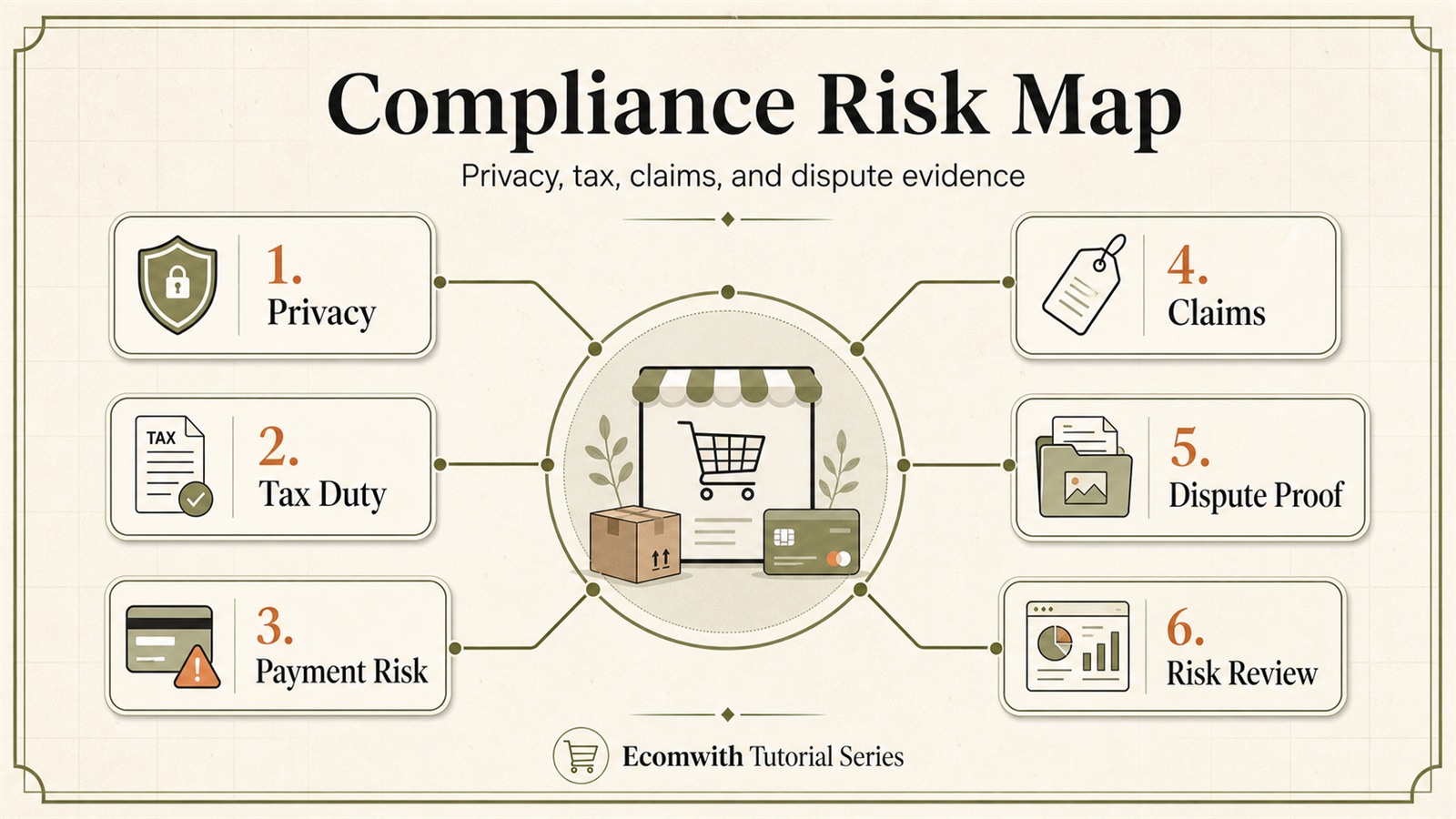
Knowledge Map
See the full route before opening each lesson
This image compresses the series into one learning map. Use it to see the full route first, then complete the matching decision, setup, or review asset in each lesson.
Use it as a series navigation map: after each lesson, return here and check which node is now complete.
Course outline
Follow the sequence and complete each lesson’s matching setup or review task.
Shopify New-Market Entry: Five Compliance Risk Checks
This lesson helps you: Before entering a new market, check whether you can sell, collect payment, and deliver. Use a pause-or-continue check to complete market evidence fields, payment cash-flow risk, and product safety or recall evidence before choosing continue, small test, pause, or escalate; record the owner and next review trigger.
Start here if you're new to this series. Then read: "Shopify Privacy, Cookies, and Consent: A Practical Check".
Shopify Privacy, Cookies, and Consent: A Practical Check
This lesson helps you: User consent decides which scripts can run, which ad signals can be used, and whether email outreach can continue. Before adding pixels, GA4 / Tag Assistant, email popups, or remarketing to Shopify, test first visit, reject, accept, and withdrawal states. Record script firing, customer request paths, recipients, and the next retest date in one reviewable consent evidence record.
Best after "Shopify New-Market Entry: Five Compliance Risk Checks". Then continue with "Shopify EU Compliance: GPSR, VAT, and IOSS Evidence".
Shopify EU Compliance: GPSR, VAT, and IOSS Evidence
This lesson helps you: Planning to sell a Shopify product in the EU? Check one country and SKU across GPSR safety ownership, VAT/IOSS display, low-value imports, DDP/DAP, and page/package promises before you go live, test small, pause, or escalate.
Best after "Shopify Privacy, Cookies, and Consent: A Practical Check". Then continue with "How to Check US Sales Tax and Chargebacks: Liability, Evidence, and Stop-Loss".
How to Check US Sales Tax and Chargebacks: Liability, Evidence, and Stop-Loss
This lesson helps you: How do you check US sales tax and chargeback risk? Use one disputed order to separate sales tax, capture, shipping, refund promise, and chargeback evidence, then use the US tax and dispute risk table to connect high-risk orders, manual capture, tax liability insights, Shopify Flow, payment gateway evidence, support and post-purchase records, the US Risk Evidence Sheet, Evidence Submission Pack fields, page and policy snapshots, state nexus verification actions, refund-to-stop-loss decision, verification date and escalation record, Visa VAMP, and copyable lesson notes. Use the 2026-07-27 official boundary review as the current reference.
Best after "Shopify EU Compliance: GPSR, VAT, and IOSS Evidence". Then continue with "How to Review Shopify Product Claims: Proof, Labels, and Page Placement".
How to Review Shopify Product Claims: Proof, Labels, and Page Placement
This lesson helps you: How to review product claims on a Shopify store: match proof, scope, and placement before launch. Treatment, certification, eco, non-toxic, age-safe, and free-trial claims cannot be written casually. Use a claims and labeling review matrix, Claim risk highlighter, and Product Claim Review Card to review risky claims across ad creative, AI/UGC, package labels, PDP, checkout, and reviews, then record responsible lead, last review date, escalation path, freeze rule, and next review trigger.
Best after "How to Check US Sales Tax and Chargebacks: Liability, Evidence, and Stop-Loss". Then continue with "How to Launch a Shopify Promotion: Discounts, Terms, and Checkout QA".
How to Launch a Shopify Promotion: Discounts, Terms, and Checkout QA
This lesson helps you: How do you check a Shopify promotion before launch? Use the Limited-Time Offer Launch Checklist and a 48-hour 20% off promo to check original price, sale price, stock, gifts, auto-add thresholds, terms, email ads, creative promises, checkout test orders, GMC trust, consent/subscription paths, first-hour monitoring, and margin release conditions.
Best after "How to Review Shopify Product Claims: Proof, Labels, and Page Placement". Then continue with "High-Risk Incident Response: What to Pause, Check, and Escalate".
High-Risk Incident Response: What to Pause, Check, and Escalate
This lesson helps you: When a high-risk incident happens, do not keep selling first. Use a high-risk incident escalation tree, platform entry quick reference, incident ID, graded evidence, communication lock template, and 24h / 72h Incident Response Runbook for Shopify payment holds, rising disputes, Google Merchant Center suspension, product safety, privacy, bot automation, and unsubscribe complaints; record the pause scope, incident impact record, system-event records, owner, and recovery condition.
Best after "How to Launch a Shopify Promotion: Discounts, Terms, and Checkout QA". Then continue with "How to Run a Quarterly Risk Review: Evidence, Owners, Pause".
How to Run a Quarterly Risk Review: Evidence, Owners, Pause
This lesson helps you: How do you run a quarterly risk review? A team can use 60 minutes each quarter to turn official changes, platform notices, payment disputes, support themes, incident logs, tool access, evidence age, and counter-signals into continue, add-evidence, and pause/escalate lists, with different review shapes for solo stores, five-person teams, and twenty-person teams.
Best used as the closing lesson after "High-Risk Incident Response: What to Pause, Check, and Escalate".
Series Execution Kit
A reusable kit that turns this series into team-ready checklists, review sheets, and next-action workflows.
Core checklist
Confirm that the most important setup, page, data, or account foundations from this series are complete.
Metric review sheet
Put the main metrics, warning signals, and decision rules from this series into one review sheet.
Next-action board
Track owner, deadline, validation metric, and next review point so learning turns into execution.
Course FAQ
Confirm the course boundaries first
Should I follow this course in order?
Yes. Each lesson produces an operating asset, and later lessons often depend on the previous decisions and materials.
What will I have after this course?
You will have the operating asset, checklist, and next actions for this course, not just a set of articles you have read.
Is this for Shopify and independent stores?
Yes. Ecomwith tutorials are designed for cross-border independent stores and Shopify workflows across pages, traffic, data, and profit.
After completing this series you will master
A systematic cross-border ecommerce knowledge system
Complete Knowledge System
Systematic learning, step by step
Practical Skills
Real cases, apply immediately
Actionable Plans
Clear path, execute directly
Share this tutorial series
Share the full series so other readers can follow the same learning sequence.