A refund is money you choose to send back to the buyer. A chargeback, also called a dispute, is a buyer's complaint to the card issuer: the bank takes the payment back from you at once, adds a fee, and leaves you to contest it with evidence. The two rates also have different denominators. A refund rate is usually refunded orders (or refunded revenue) divided by orders (or revenue). A chargeback rate is disputes divided by transactions, and Visa, Mastercard, Stripe and Shopify each take the numerator and denominator differently. The lines you can check in official documents today: Visa's VAMP puts the Excessive merchant line in the US, Canada, the EU and Asia Pacific at a 1.5% ratio with at least 1,500 fraud and dispute events in the month, and Mastercard's ECM needs both 100 chargebacks and 1.5%.
This is general information, not legal, tax or financial advice. Card network rules change often. Each number below carries its source and check date, and if you are affected, rely on the notice from your acquirer or payment provider.
Three terms to separate first
| Who starts it | What happens to the money | What you can do | Counted by card network monitoring? | |
|---|---|---|---|---|
| Refund | You | You decide the amount, and the money returns to the buyer's original payment method | Your decision | No. Stripe states that monitoring programs do not consider refunds when identifying disputes |
| Chargeback | The buyer, through the card issuer | The amount and a chargeback fee are withdrawn immediately; if you win, the amount comes back and the fee may be refunded depending on your country or region | Submit evidence within the deadline (usually 7 to 21 days); the issuer decides, taking up to about 75 days; the outcome is final | Yes, whether you win or lose |
| Inquiry | The buyer, through the card issuer | Shopify says the bank does not take the amount or a fee right away during an inquiry | Provide evidence or refund; an unanswered inquiry can escalate to a chargeback | An inquiry that does not escalate is not a dispute |
The sources disagree on one point. Shopify's help pages still treat an inquiry as a kind of bank-initiated case. Stripe says Visa and Mastercard no longer use an inquiry stage and that it mostly appears with American Express and Discover. Use the status shown in the back office of whichever channel you collect through.
Refunds staying out of monitoring has limits. A Visa early fraud warning can still arrive on a refunded transaction; the exception is a refund processed as a reversal within about two hours of capture. Mastercard also counts a chargeback that a refund would otherwise have hidden.
PayPal uses its own terms. PayPal's developer documentation (marked updated 2026-06-11) splits disputes into internal and external. A dispute the buyer opens in PayPal's Resolution Center is internal: buyer and merchant have up to 20 days to settle it, and if it is escalated to a claim, PayPal decides. A dispute the buyer opens with the bank or card issuer is external, which is a chargeback, and the bank decides while PayPal passes information and evidence along. Buyers have 180 days from the payment date to open a dispute in PayPal.
How to calculate: the denominator decides the number
Start with the site's refund rate answer. Refund rate can be refunded orders divided by total orders, or refunded revenue divided by total revenue, and you must keep one definition. Chargeback rates have more variants. The table below puts the official wording side by side.
| Source | Numerator | Denominator | Checked |
|---|---|---|---|
| Shopify Help Center (chargeback rate) | Chargebacks received in the month, including ones you win; a second rate also includes disputes auto-resolved through a network dispute resolution program | Chargeback-eligible transactions in the same month (Shopify Payments only) | 2026-11-03 |
| Visa VAMP (Visa fact sheet, as cited by Stripe and Shopify) | Disputes (TC15) plus fraud warnings (TC40) | Settled transactions in the month | 2026-11-03 |
| Mastercard ECP (as cited by Stripe and Shopify) | Chargebacks raised in the month | Captured payments in the preceding month | 2026-11-03 |
| Stripe dispute activity | Disputes received in the period | Successful payments in the period | 2026-11-03 |
| Stripe dispute rate | Disputes that came from the period's payments | Successful payments in the period | 2026-11-03 |
Change the formula and the number changes. Here is a fictional store with assumed numbers. In October it captured 800 payments. In November it captured 1,000 payments for USD 60,000 of revenue, refunded 60 orders for USD 3,300, received 4 chargebacks (2 of them from November orders) and received 3 Visa early fraud warnings. To compare formulas, the same counts go through each one; in reality each network counts only its own transactions.
| Basis | Calculation | Result |
|---|---|---|
| Refund rate (orders) | 60 ÷ 1,000 | 6.0% |
| Refund rate (amount) | 3,300 ÷ 60,000 | 5.5% |
| Shopify-style chargeback rate | 4 ÷ 1,000 | 0.40% |
| Mastercard ECP-style | 4 ÷ 800 (prior-month captures) | 0.50% |
| Visa VAMP-style | (4 + 3) ÷ 1,000 | 0.70% |
| Stripe dispute rate (by charge date) | 2 ÷ 1,000 | 0.20% |
The refund rate and the chargeback rate differ by an order of magnitude because they measure different things. One shows whether the product or the expectation is failing. The other shows buyers going around you to the bank. Blend them into one figure and both become unreliable.
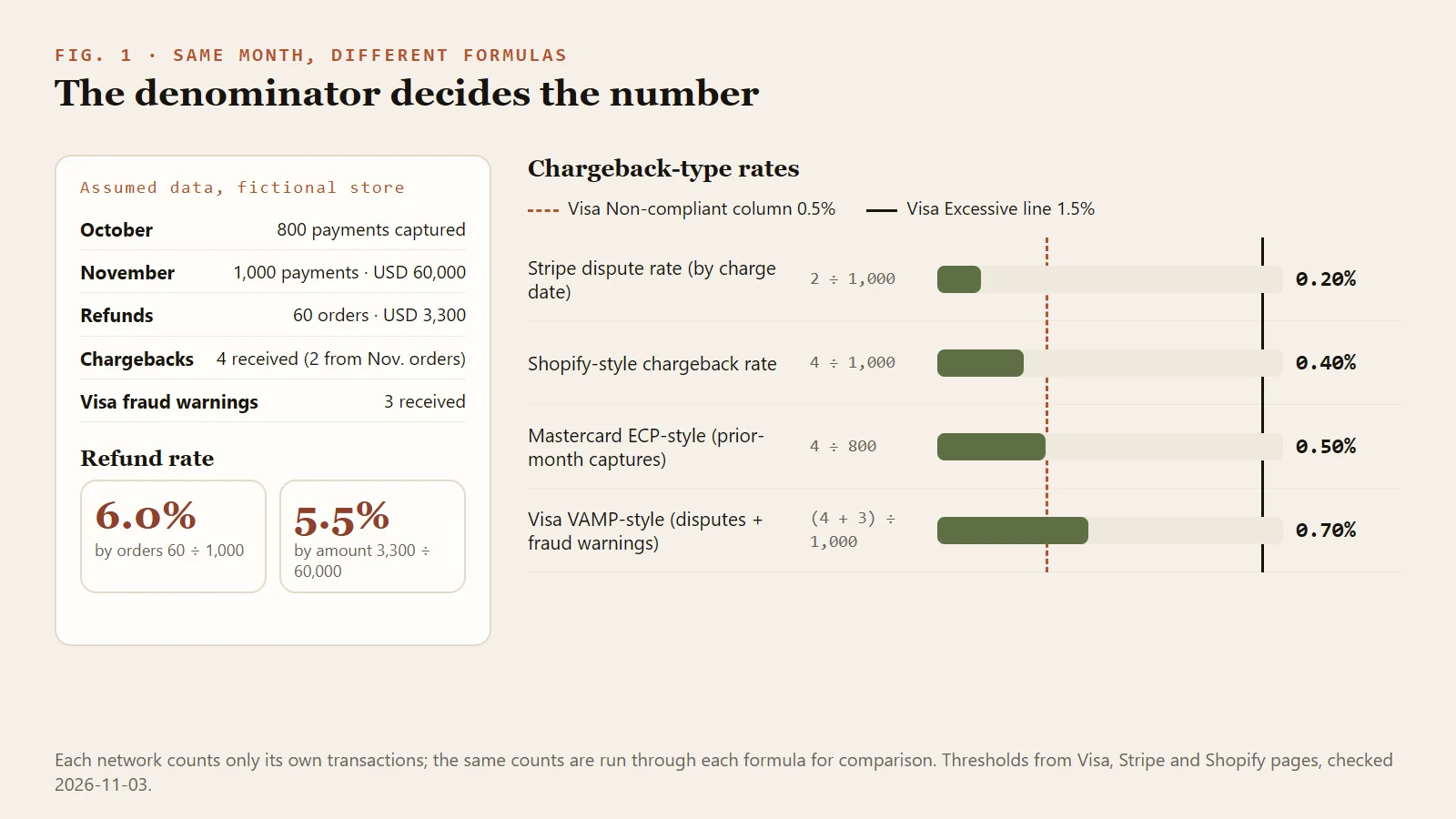
Figure 1: One set of assumed data produces different numbers under different formulas.
Thresholds: only what official documents state
These are the monitoring lines the documents state today. They get adjusted, so recheck on the linked pages before relying on them.
| Program | Condition | Source and date |
|---|---|---|
| Visa VAMP, Excessive merchant line (US, Canada, EU, Asia Pacific) | 1.5% ratio and at least 1,500 fraud plus dispute events a month | Visa's 2025 VAMP fact sheet, which notes this line moved from 2.2% to 150 basis points on 2026-04-01; Stripe and Shopify pages agree; checked 2026-11-03 |
| Visa VAMP, Excessive merchant line (Latin America) | 1.5% ratio, at least 1,500 events a month | Same |
| Visa VAMP, Excessive merchant line (Central Europe, Middle East, Africa) | 2.2% ratio, at least 150 events and USD 75,000 | Same |
| Visa VAMP, Non-compliant column | 0.5% ratio, count of 5 | Stripe and Shopify tables, 2026-11-03; the Visa fact sheet does not list this column |
| Mastercard ECM | At least 100 chargebacks in the month and a chargeback rate from 1.5% to 2.99% | Stripe and Shopify pages, 2026-11-03 |
| Mastercard HECM | At least 300 chargebacks in the month and a rate of 3% or more | Same |
Two things matter when you read this. First, most programs require both count and ratio. The fictional store above has 4 chargebacks, so even if its ratio came out above 1.5% it could not enter Mastercard's ECM, whose floor is 100. Second, Visa's Non-compliant column is much smaller, at 5 events and 0.5%, so small stores can reach it: the example's 0.70% and 7 events are both above those figures. Stripe says Visa may assess fees at that level, so ask your acquirer how it is applied.
One caveat about what was read: Mastercard's own rule documents could not be retrieved (the public files we tried refused access), so the Mastercard lines come from Stripe and Shopify. Separately, Stripe notes that the card-processing industry treats dispute activity above 0.75% as excessive and that a sudden spike can trigger monitoring earlier. That is Stripe's statement of convention, not a card network rule.
Cost: money and the account
By these documents a lost chargeback costs the transaction amount, the dispute fee, and the goods already shipped. Shopify says the disputed amount and a chargeback fee are withdrawn immediately; if you win you get the amount back, and the fee may be refunded depending on your country or region. Stripe says it debits the amount plus a dispute fee, that outside Mexico the fee for receiving a dispute is not refundable, and that contesting a dispute adds a countered fee that is returned if you win. Fees depend on where your business is located, so check your own pricing page. This article gives no amounts.
The account side is heavier. Shopify says a high chargeback rate can lead to a reserve or to enrollment in a network dispute resolution program, and that a rate that stays high can bring card network fines or the loss of your ability to process cards. Closed-account records on lists such as MATCH can also lead new processors to decline you. A rising refund rate is one of the signals Shopify lists when it decides on a reserve, which connects directly to the reserve discussion in Mainland China entity selling on Shopify: how to choose a payment route.
So a refund is not always the worse outcome. Stripe notes that while a dispute is open you cannot refund outside the dispute process, and a refund made before a dispute usually stops the buyer from going to the bank. Refund early to resolve a real complaint, not to manage monitoring counts. Judge each order by its amount, the strength of your evidence and the dispute fee, rather than refusing refunds across the board.
Prevention checklist
Shopify's and Stripe's advice overlaps heavily. Merged, with the dispute reason each item addresses:
- A recognizable billing descriptor (fraud, unrecognized charge). Set the statement text to your store name or domain. In Shopify Payments you can set it in the admin.
- A receipt after payment (fraud, duplicate charge). State what was bought and the amount, and label similar orders separately.
- Shipping and delivery proof (item not received). Ship quickly, send tracking, contact the buyer about delays, and consider signature confirmation for high-value goods.
- Response speed. Answer a worried buyer before they call the bank, and keep your contact details easy to find.
- A clear policy (not as described, credit not processed). Make the return policy findable and specific, and issue refunds you owe promptly.
- Accurate listings (not as described). Photos and descriptions that match the goods, and packaging that survives transit.
- Fraud screening. Review suspicious orders before shipping. For orders to the US, UK and Canada, consider shipping only when the AVS check passes. Stripe also suggests separating authorization from capture and using review rules, because issuers report fraud only on captured payments. Use these to stop genuinely suspicious orders, not to manage monitoring counts.
- Subscriptions. An easy cancellation route and a reminder before each renewal.
When you submit evidence, Shopify's advice is to put the strongest first: direct proof such as delivery confirmation with signature, carrier tracking matching the address, or the refund record, then customer acknowledgment such as an email confirming receipt, then policy and order details. Prepare by reason. Item not received needs tracking, proof of delivery and address verification. Fraud needs matching AVS and CVV, and device or IP data consistent with past orders. A duplicate charge needs the transaction logs and a receipt for each charge. A wrong-amount dispute needs an itemized receipt and your pricing policy.
Connecting this to profit and cash
Both rates end up in the profit statement. Every refund reduces contribution margin directly, however high ROAS looks, and every lost chargeback adds a fee and the shipped goods to the loss. Write your refund assumption into pricing and ad thresholds; see real ecommerce profit before pricing and ROAS is not profit. Reserves and delayed payouts tie up cash, and the 90-day cash runway guide covers how to keep a buffer. For a short definition of the rate itself, see the chargeback rate answer.
Frequently asked questions
What is the difference between refund rate and chargeback rate?
Refund rate counts the orders or amounts you chose to return, and it tells you whether product, expectation or fulfillment is failing. Chargeback rate counts disputes the buyer opened with the bank and the bank has already debited, and card networks use it to assess account risk. The two use different numerators and denominators and do not substitute for each other.
What chargeback rate counts as high?
It depends on the program. Visa's Excessive merchant line is 1.5% with at least 1,500 events in the month in the US, Canada, the EU and Asia Pacific. Mastercard's ECM needs at least 100 chargebacks and 1.5%. Stripe adds that the industry treats above 0.75% as excessive. Small stores often fall short on counts, but a high ratio still makes your payment provider cautious.
If I win a chargeback, does it still count toward my rate?
Yes. Shopify and Stripe both state that monitoring counts the disputes that occur, not how they end, so a dispute you win still counts.
Can I refund the buyer after they open a dispute?
Stripe says you cannot refund outside the dispute process while a dispute is open. Follow your channel's instructions: submit evidence or accept the dispute. Refunding before a dispute is usually cheaper, though for a fraud warning Stripe notes the refund does not erase the warning record. Refund early to resolve a real complaint, not to manage monitoring counts.
What matters most when submitting evidence?
Submit before the deadline and put the strongest proof first. Shopify points out that the reviewer may spend only a few minutes on a case. The usual core evidence is proof of delivery, address verification, device or IP data from the order, and the policy and communication records.
Sources
Last verified: 2026-11-03.
- Visa Acquirer Monitoring Program fact sheet (2025)
- Stripe: dispute and fraud card monitoring programs
- Stripe: how disputes work
- Stripe: measuring disputes
- Shopify: chargebacks and inquiries, responding and evidence, preventing
- Shopify: monitoring your chargeback rate, fraud and dispute monitoring programs
- Shopify: reserves in Shopify Payments
- PayPal developer documentation: disputes overview