Shopify Profit Review: ROAS, Contribution Profit, Cash Flow, and Finance Decisions
Learn how Shopify profit review connects ROAS, CPA, order revenue, COGS, fulfillment, payment fees, refunds, inventory cash, and channel quality to contribution profit and operating decisions.
Quick Answers
TL;DR: This series is step-based; follow in order and complete each practical lesson.
Q: Should I follow the order?A: Yes, later lessons often depend on earlier concepts.
Independent-store operators who want to practice decisions and actions through complete cases.
Start with lesson one. If joining midway, complete the prior lesson check or record first.
Complete the series checklists, decision records, and next actions so the same operating standard can be reviewed again.
Best for readers willing to complete the exercises and records in order. For one specific concept, open the matching lesson directly.
2026-07. Maintained by Ranfeng Wei. Reviewed monthly against Shopify, Google Search, ads, analytics, and ecommerce operating workflows.
Who Should Start Here
Best for Shopify and independent-store operators who want to carry the course checks, decisions, and actions directly into team execution.
Most Critical Lessons
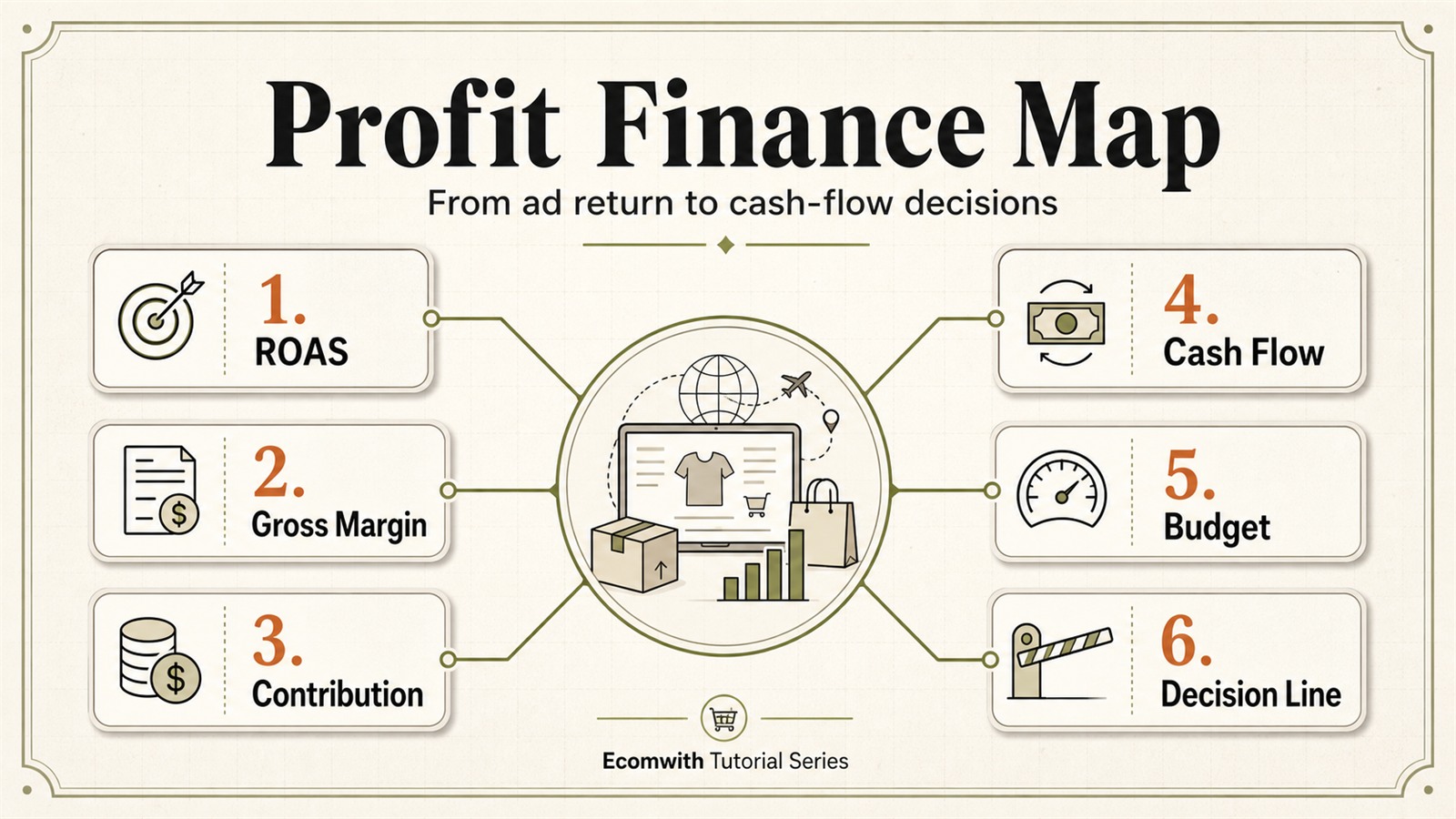
Knowledge Map
See the full route before opening each lesson
This image compresses the series into one learning map. Use it to see the full route first, then complete the matching decision, setup, or review asset in each lesson.
Use it as a series navigation map: after each lesson, return here and check which node is now complete.
Course outline
Follow the sequence and complete each lesson’s matching setup or review task.
DTC Profit Model: What One Order Really Earns
This lesson helps you: When ad dashboards look good but cash is still tight, run a $79 PetNest US Shopify order through revenue, discount, COGS, fulfillment, payment fee, refund reserve, and CPA to see post-ad contribution profit. Then reconcile ads, Shopify, and payout reports to the same orders before continuing, pausing, or filling evidence.
Start here if you're new to this series. Then read: "Order Costs: COGS, Shipping, Payment Fees, and Refunds".
Order Costs: COGS, Shipping, Payment Fees, and Refunds
This lesson helps you: Use a May 2026 US Shopify $49 20oz tumbler after-sales exception order to see why $36 product margin becomes $10.20 post-refund contribution profit, then connect support, warehouse, payout, and carrier proof in one reviewable sheet.
Best after "DTC Profit Model: What One Order Really Earns". Then continue with "SKU Contribution Profit: Which Products Deserve More Spend".
SKU Contribution Profit: Which Products Deserve More Spend
This lesson helps you: Use six priority SKUs from a May 2026 US Shopify review, including the organizer's $20.20 - $6 = $14.20 path and the tumbler's CPA and stock shortfall, to build a contribution ladder before choosing scale, maintain, observe, clean-up, or ad-group actions.
Best after "Order Costs: COGS, Shipping, Payment Fees, and Refunds". Then continue with "Promotion Profit Guardrails: Discounts, Free Shipping, and Refunds".
Promotion Profit Guardrails: Discounts, Free Shipping, and Refunds
This lesson helps you: Use a May 2026 US Shopify $79 20oz tumbler list-price scenario to calculate $67 - $23 - $6 - $2.50 - $5 - $16 = $14.50 and the stacked -$3.50 path before approving, reducing, or pausing the promotion.
Best after "SKU Contribution Profit: Which Products Deserve More Spend". Then continue with "Cash Flow and Inventory: How to Pace Ads and Replenishment".
Cash Flow and Inventory: How to Pace Ads and Replenishment
This lesson helps you: Use a May 2026 US Shopify 20oz tumbler cash rhythm to calculate $1,200 × 7 = $8,400 and 21 - 12 = 9, then use dated cash-low-point evidence in a four-week calendar before raising budget, keeping core ads, funding stock, or pausing tests.
Best after "Promotion Profit Guardrails: Discounts, Free Shipping, and Refunds". Then continue with "Channel Profitability: Why the Same ROAS Can Produce Different Profit".
Channel Profitability: Why the Same ROAS Can Produce Different Profit
This lesson helps you: Use May 2026 US Shopify Meta 50-order and Google 32-order cohorts from one 20oz product line to verify `$3,950 - $1,100 - $350 - $152 - $356 - $180 - $1,580 = $232`, then set a bounded budget move for the same 2.5 ROAS after attribution and deduplication are fixed.
Best after "Cash Flow and Inventory: How to Pace Ads and Replenishment". Then continue with "Weekly Business Review: Revenue Up but Profit Down".
Weekly Business Review: Revenue Up but Profit Down
This lesson helps you: Use a May 2026 US Shopify 20oz tumbler weekly variance to work `$10,000 × 1.18 = $11,800`, `$2,000 × 0.89 = $1,780`, and the discount-exposure bridge before setting finance-WBR evidence, one owner, next-week acceptance, and an escalation line.
Best after "Channel Profitability: Why the Same ROAS Can Produce Different Profit". Then continue with "Monthly Finance Review: Scale, Cut, or Pause Next Month".
Monthly Finance Review: Scale, Cut, or Pause Next Month
This lesson helps you: Use a May 2026 US Shopify 20oz tumbler Google Shopping high-margin product group to verify `$1,280 × 20% = $256`, `$1,280 + $256 = $1,536`, and `21 - 21 = 0` stock buffer before turning three-week contribution proof, cash low point, and rollback lines into a next-month rule.
Best used as the closing lesson after "Weekly Business Review: Revenue Up but Profit Down".
Series Execution Kit
A reusable kit that turns this series into team-ready checklists, review sheets, and next-action workflows.
Core checklist
Confirm that the most important setup, page, data, or account foundations from this series are complete.
Metric review sheet
Put the main metrics, warning signals, and decision rules from this series into one review sheet.
Next-action board
Track owner, deadline, validation metric, and next review point so learning turns into execution.
Course FAQ
Confirm the course boundaries first
Should I follow this course in order?
Yes. Each lesson produces an operating asset, and later lessons often depend on the previous decisions and materials.
What will I have after this course?
You will have the operating asset, checklist, and next actions for this course, not just a set of articles you have read.
Is this for Shopify and independent stores?
Yes. Ecomwith tutorials are designed for cross-border independent stores and Shopify workflows across pages, traffic, data, and profit.
After completing this series you will master
A systematic cross-border ecommerce knowledge system
Complete Knowledge System
Systematic learning, step by step
Practical Skills
Real cases, apply immediately
Actionable Plans
Clear path, execute directly
Share this tutorial series
Share the full series so other readers can follow the same learning sequence.