
A GTIN example shows how a product identifier is written and how its final check digit is calculated. GTINs have 8, 12, 13, or 14 digits. A number can have the expected length and a correct check digit without being assigned to your product, licensed to your business, or accepted by a sales channel. Use examples to understand the structure; obtain commercial identifiers through the appropriate GS1, brand, manufacturer, or verified supplier records.
The numbers below are arithmetic illustrations. They are not offered as commercial allocations, and their assignment status has not been checked. Do not copy them into a real listing, product label, or supplier record. This distinction matters even when an example looks realistic and a calculator returns a passing result. The calculation answers a question about the digits, while the commercial record answers a question about the trade item.
For the short definition, see what a GTIN identifies. This article focuses on reading examples, understanding the calculation, and interpreting what a result can establish. GS1 provides the GTIN standards context; its standard is separate from any local tool that checks number structure.
Four lengths, with one arithmetic rule
The length includes the final check digit. A 13-digit example therefore contains twelve preceding digits and one check digit. Do not append another digit to a complete identifier just because a calculator asks for an incomplete number. Some interfaces calculate a missing digit; others validate a complete value. Read the input description before interpreting the result.
| Format | Digits before the check digit | Arithmetic illustration | Final check digit | Appropriate interpretation |
|---|---|---|---|---|
| GTIN-8 | 7 | 12345670 |
0 |
Eight digits with matching check-digit arithmetic |
| GTIN-12 | 11 | 012345678905 |
5 |
Twelve digits; the first zero is part of the representation |
| GTIN-13 | 12 | 1234567890128 |
8 |
Thirteen digits with a matching final digit |
| GTIN-14 | 13 | 12345678901231 |
1 |
Fourteen digits; no packaging assignment is implied |
Every row has the same limitation: the example is not evidence of a commercial allocation. A series of plausible digits does not identify its rightful user merely by looking familiar. You also cannot use the table to decide that a product should receive whichever length is most convenient for a form. The identifier associated with the actual trade item remains the starting point.
GTIN-12 is commonly associated with UPC and GTIN-13 with EAN. A barcode is the machine-readable carrier; the GTIN is the identifier it carries. In everyday conversation people often use these terms loosely. When someone sends “the barcode,” establish whether they mean the complete digit string, an image of the printed symbol, or a field in a product system. Those are useful but different objects of comparison.
The GS1 Canada explanation of GTINs supplies context for company prefixes, item references, check digits, and packaging configurations. Do not infer the boundary between a company prefix and an item reference from an arbitrary split of the example. The final digit is easy to locate; the preceding commercial components require the relevant allocation context.
Read a complete example from the right
Take the illustrative GTIN-13 1234567890128. The final 8 is the check digit. The preceding sequence is 123456789012. Starting with the rightmost digit of that preceding sequence, multiply by 3, then 1, then 3, and continue alternating toward the left. Add the products. The check digit is the amount needed to bring that sum to the next multiple of ten, using zero when the sum already ends in zero.
| Position from the left in the preceding sequence | Digit | Weight | Product |
|---|---|---|---|
| 1 | 1 | 1 | 1 |
| 2 | 2 | 3 | 6 |
| 3 | 3 | 1 | 3 |
| 4 | 4 | 3 | 12 |
| 5 | 5 | 1 | 5 |
| 6 | 6 | 3 | 18 |
| 7 | 7 | 1 | 7 |
| 8 | 8 | 3 | 24 |
| 9 | 9 | 1 | 9 |
| 10 | 0 | 3 | 0 |
| 11 | 1 | 1 | 1 |
| 12 | 2 | 3 | 6 |
The sum is 92. The next multiple of ten is 100, so the check digit is 8. Appending it produces 1234567890128. A compact expression is check digit = (10 - (weighted sum mod 10)) mod 10. The final modulo operation handles sums already divisible by ten: a sum of 60 produces a check digit of zero, not a two-character ending of 10.
For the GTIN-8 illustration, the preceding seven digits are 1234567. Reading their weights from left to right gives 3, 1, 3, 1, 3, 1, 3. The products sum to 60, so the complete example ends in zero: 12345670. This also explains why memorizing a fixed left-to-right starting weight is unreliable across lengths. Starting from the rightmost digit before the check digit keeps the method consistent.
The eleven preceding digits of 012345678905 produce a weighted sum of 85, giving a check digit of 5. The thirteen preceding digits of 12345678901231 produce 109, giving a check digit of 1. These are calculations performed on illustrative strings, not identifiers attributed to a named company or item. You can reproduce the arithmetic without making any claim about registration.
The Ecomwith GTIN tool can help with structure and check-digit checks. Its result is a mechanical aid for development or feed QA. It does not allocate a GTIN or establish that a product is entitled to use a number. This article explains the interpretation of examples, rather than the tool's implementation or barcode export behavior.
What a failed check tells you
If the same twelve preceding digits appear as 1234567890129, the final digit does not agree with the calculation. That is a useful failure: the complete value should not be treated as internally consistent. It does not tell you which digit was copied incorrectly. The error could be in the last position, in an earlier position, or in the process that assembled the string.
Suppose a supplier record contains the ending 8 and a spreadsheet contains the ending 9. Comparing the two complete strings gives a specific discrepancy to investigate. Recalculating the last digit can show what the arithmetic expects, but the supplier evidence still needs to match the relevant trade item. If the earlier digits were wrong, changing only the last digit could produce another passing string that remains unrelated to the product.
There is also a useful counterexample to the idea that a check digit catches every mistake. The preceding sequences 123456789012 and 623451789012 have weighted sums of 92 and 82 respectively. Both sums leave a remainder of 2 when divided by ten, so both complete illustrative strings end in 8. The changes have altered the total by ten while preserving its remainder. This is an arithmetic demonstration of a limit, not an estimate of how often catalog errors occur.
A passing result consequently cannot replace a comparison with the original source. Check digits help identify some transcription errors; they do not provide a signature from the brand owner or a guarantee that every digit is correct. Preserve the source value when an inconsistency appears. Record the competing values and resolve the evidence before treating a recalculated string as a correction for a real product.
Leading zeroes are part of the data
The GTIN-12 illustration 012345678905 contains twelve digits. If a spreadsheet treats it as an ordinary number, it may display or export 12345678905, which contains eleven. The visible difference is small, but the original identifier representation has been lost. Store identifier values as text when preparing examples or comparing supplier data, and inspect the exported value as well as the cell display.
There is a separate, legitimate concept: a shorter GTIN can be represented in a fixed 14-digit field by adding leading zeroes. For example, the same illustrative GTIN-12 can be displayed as 00012345678905 in that representation. Its existing check digit remains at the right. The added zeroes do not create a newly assigned trade item or transform a retail unit into a shipping case.
These two situations need different explanations. Losing a zero during numeric conversion is a data-preservation problem. Adding zeroes to meet a documented fixed-width representation is normalization. Keep the original value and record which representation is required by the destination. Do not assume that every form, spreadsheet, channel, or printed barcode expects fourteen digits simply because one database does.
The direction of the change matters as well. Adding a zero at the left does not have the same effect as inserting one in the middle or appending one at the right. A zero at the right would displace the old check digit into the preceding sequence and change the calculation. Comparing only the number of digits will miss that difference; compare the entire string and the intended transformation.
For a training exercise, place the original twelve-digit string beside its fourteen-digit representation and label the relationship explicitly. Do not describe them as two allocations. If a reviewer sees two catalog rows containing these values, the representation alone is insufficient to establish whether the rows describe separate products. They need the product records and the documented normalization rules to interpret the apparent difference.
Separate four questions before using an example
“Valid” is an incomplete label unless it identifies the test. A format validator, an allocation record, a product specification, and a channel result answer different questions. Combining them into one green status makes it difficult to see what is still unknown. Use the most specific description that the evidence supports.
| Question | Evidence that can address it | What that evidence does not establish |
|---|---|---|
| Is the string structurally consistent? | Supported length, numeric characters, and check-digit arithmetic | Commercial allocation or product association |
| Was the identifier assigned through the appropriate route? | Relevant GS1, brand, manufacturer, or verified supplier records | That the item currently being sold is the matching configuration |
| Does the record correspond to this trade item? | Product and packaging evidence tied to the identifier | A current sales-channel processing result |
| What did the destination do with the submitted data? | The destination's processed item and issue state | A general ownership guarantee or acceptance by every other channel |
The product-association question deserves its own line. A number can belong in legitimate records and still be wrong for the item on your desk. A single bottle and a case of bottles may be different trade items. Two variants can share much of their product description while requiring separate identifier evidence. The example string itself cannot decide those relationships.
Likewise, an uploaded value is not the same thing as a processed value. Google provides guidance on finding a GTIN, including where merchants should obtain product identifiers. Consult the destination's actual requirements and item evidence when making a commercial submission. A local arithmetic pass is not a Merchant Center acceptance receipt, and the receipt is not a promise of visibility or sales.
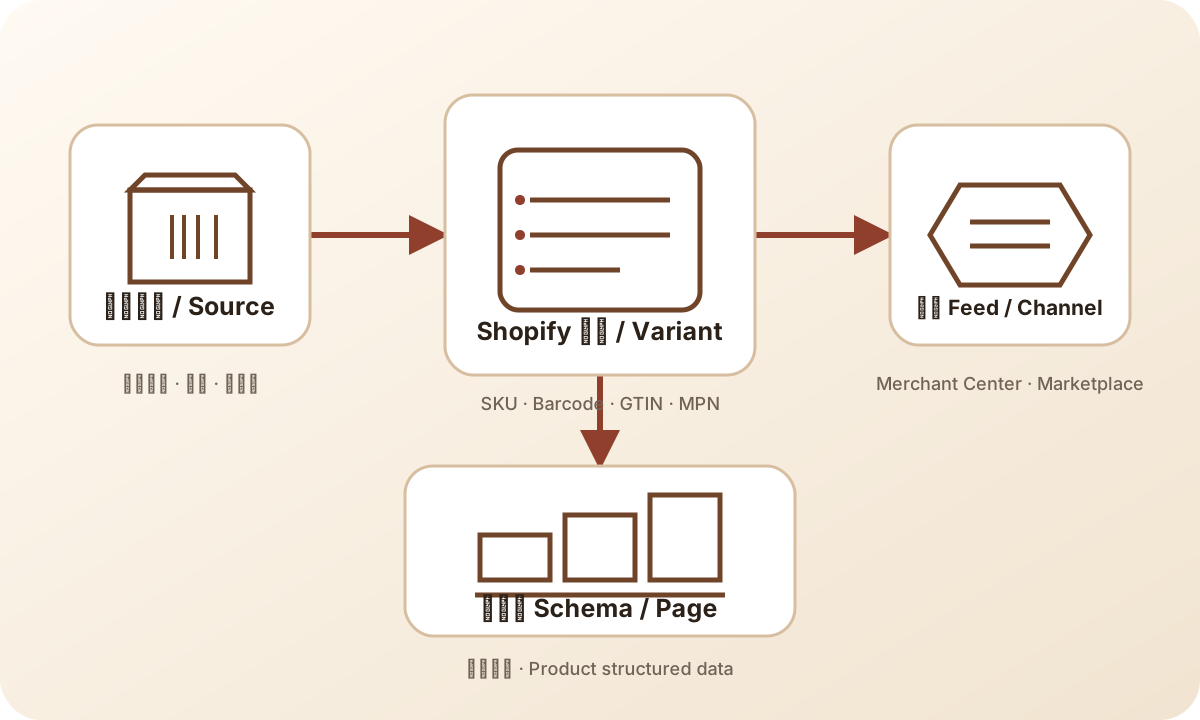
The diagram shows why the same string may appear in several places. Each appearance has a different role: source evidence, a store field, a channel input, or page markup. Reading the string in one place does not establish what another place has received or processed. The product schema versus product feed answer explains that separation when both surfaces are involved.
A realistic supplier-sheet example
Consider a hypothetical shop preparing a new bottle listing. The supplier sends a sheet with a unit description, a case description, and an identifier column. The shop also has a spreadsheet used for staff training. An arithmetic example from that training sheet happens to have a correct length and check digit. None of that makes the training value the bottle's identifier.
Start by distinguishing the three objects: the saleable unit, the supplier's case configuration, and the teaching example. The shop needs evidence connecting its actual saleable item to the appropriate supplier record. A case number cannot be selected simply because it fits the available field. A training value cannot fill a blank while the commercial record is being requested. A format test does not resolve either choice.
Suppose the supplier's relevant value begins with zero and the imported sheet loses that zero. The team can document the discrepancy between the source text and the imported text. That observation supports repairing the data-preservation step. It does not support inventing a new number or making a claim that the channel will now accept the listing. The scope of the finding is precise: one representation changed during import.
Now suppose a colleague says that both the unit and case numbers pass the calculator. That result is compatible with the two records representing different trade items. The next evidence is the supplier's product and packaging association, not a second calculation. If the source does not distinguish the configurations clearly, the choice remains unresolved. A photograph of a case label should not silently become evidence for an individual bottle.
The useful outcome of this example is a well-defined interpretation, rather than a fictional approval. The team can say which string passed the arithmetic, which record supplied it, and which item association is still missing. This article does not claim that the hypothetical shop obtained an allocation, fixed a rejection, or improved performance. The scenario illustrates what each piece of evidence would allow a merchant to conclude.
For a broader explanation of product identity, continue with what a GTIN identifies in a product feed. If the question has moved to a reported missing value, use the separate missing GTIN diagnosis. Those articles own the definition and warning investigation; repeating either process here would obscure the narrower purpose of the examples.
Reading a label, screenshot, or copied number
A printed label is often the most accessible place to find a candidate number, but an example exercise should specify what was actually read. A photo may show the outer packaging rather than the unit being sold. A screenshot may crop the first digit. A text export may remove spacing or leading zeroes. Record those limitations before concluding that two values disagree.
Spaces can help people read long digit strings, yet they are not part of the numeric GTIN itself. Keep a raw transcription alongside any cleaned comparison value when working through an example. That makes it possible to explain what was removed and why. A cleanup that strips every nonnumeric character from a sentence can accidentally join a quantity, date, or reference number to the candidate identifier.
Similarly, do not use the nearest visible number as the GTIN just because it has an expected length. Packaging can carry several references. Establish which one the source identifies as the product identifier. If the label cannot be read confidently, obtain a clearer source or a matching product record. Passing the check-digit calculation after an uncertain transcription does not repair the uncertainty in the original reading.
For comparison work, a useful note is “twelve digits transcribed from the unit record; leading zero preserved; arithmetic passes; commercial association requires source confirmation.” It is much more informative than “barcode verified.” The longer note states both the observation and its limit. A reviewer can then decide whether they need a better image, a supplier response, or a different product record.
Use examples for exercises without turning them into inventory
An example set can teach several distinct cases: a matching check digit, a mismatched final digit, a lost leading zero, and a fourteen-digit representation of a shorter value. Label each row with its purpose and expected mechanical result. This keeps learners from treating every realistic-looking row as an approved catalog entry. It also prevents the correct answer to one exercise from being reused as a business decision.
A failed example should explain the failure being illustrated. If the intended lesson is an incorrect final digit, keep the preceding sequence constant and name the expected ending. If the lesson is leading-zero loss, preserve the original string beside the damaged one. Changing several things without explanation makes the exercise ambiguous: the learner may detect a problem but misunderstand which transformation caused it.
Keep teaching material separate from live product inputs. A note beside the number should say that it is illustrative and that its allocation status is not established. The same note belongs with any exported exercise, because a copied spreadsheet may lose the surrounding article. Passing examples need this label just as much as failing examples: a successful calculation is exactly what makes them easy to misuse.
This is not a claim that the example strings occupy a reserved testing range. No reserved status is asserted here. They may overlap real allocations, which is another reason not to place them on commercial labels or listings. When a training environment can transmit to a real destination, use the destination's documented testing arrangements and approved data; do not infer permission from the word “test” in a filename.
Describe the result so another person can reproduce it
When sharing an exercise, include the complete input, the chosen length, the preceding sequence, the weighted sum, and the expected final digit. A screenshot showing only a green result omits the input that produced it. Someone receiving that screenshot cannot tell whether the original leading zero was included or whether the calculator was given a complete value instead of an incomplete sequence.
For the thirteen-digit illustration, a reproducible note would identify the input as 1234567890128, the preceding sequence as 123456789012, the weighted sum as 92, and the expected ending as 8. It would then state that assignment and product association were not investigated. This is enough to repeat the arithmetic and understand its limit without presenting the exercise as a supplier verification record.
If a different result appears, compare the input strings before debating the calculation. Count the characters, check the rightmost position, and distinguish spaces added for readability from actual digits. A discrepancy in the inputs means the two people have not yet calculated the same example. Once the strings agree, the table of weights makes an arithmetic disagreement much easier to locate.
Checklist for interpreting a GTIN example
- Identify whether you have a complete value or the preceding digits for a calculation.
- Count every digit, including leading zeroes and the final check digit.
- Confirm that the proposed format has 8, 12, 13, or 14 digits.
- Calculate from the rightmost preceding digit with alternating weights of 3 and 1.
- Compare the expected check digit with the actual ending; do not silently rewrite a commercial record.
- Preserve the original string when normalization or transcription changes its presentation.
- Label a teaching example as illustrative, with allocation and product association unverified.
- Keep allocation evidence, trade-item evidence, and channel processing separate from the mechanical result.
This checklist is for understanding the example in front of you. A catalog release requires a wider process, and a disputed allocation requires appropriate source verification. The product-data ownership lesson covers the broader responsibility question; feed debugging covers the complete investigation method. Both remain separate tutorials rather than steps embedded in this article.
Frequently asked questions
Can I use a GTIN example for a product I sell?
No. An example demonstrates structure or arithmetic and does not establish commercial allocation or association with your product. Obtain the relevant identifier from the appropriate GS1, brand, manufacturer, or verified supplier records. The examples here are not claimed to be reserved for testing.
Does a correct check digit prove that the GTIN is genuine?
It proves only that the final digit agrees with the weighted calculation for that string. It does not prove allocation, ownership, product association, or channel acceptance. Multiple incorrect changes can also leave the calculation passing, so compare the complete value with its source.
Should I remove leading zeroes?
Preserve the source identifier as text. A documented fixed 14-digit representation can add leading zeroes to a shorter GTIN, but that is different from losing zeroes through numeric conversion. Follow the destination's representation requirements without inventing a new trade item.
Can I fix a failing GTIN by replacing its last digit?
For an arithmetic exercise, you can calculate the expected ending. For a commercial record, a failure does not identify which position is wrong. Compare the complete value with the authoritative product source before changing it; recalculating the last digit can conceal an earlier error.
Sources and related reading
- GS1: Global Trade Item Number — identification and standards context.
- GS1 Support: What is a product identifier? — identifier terminology.
- GS1 Canada: Global Trade Item Numbers — components, check digits, and packaging context.
- Google Merchant Center: Find a GTIN — obtaining identifiers for product data.
Use the GTIN and product-data topic path to find the next article for the question your example leaves unresolved.