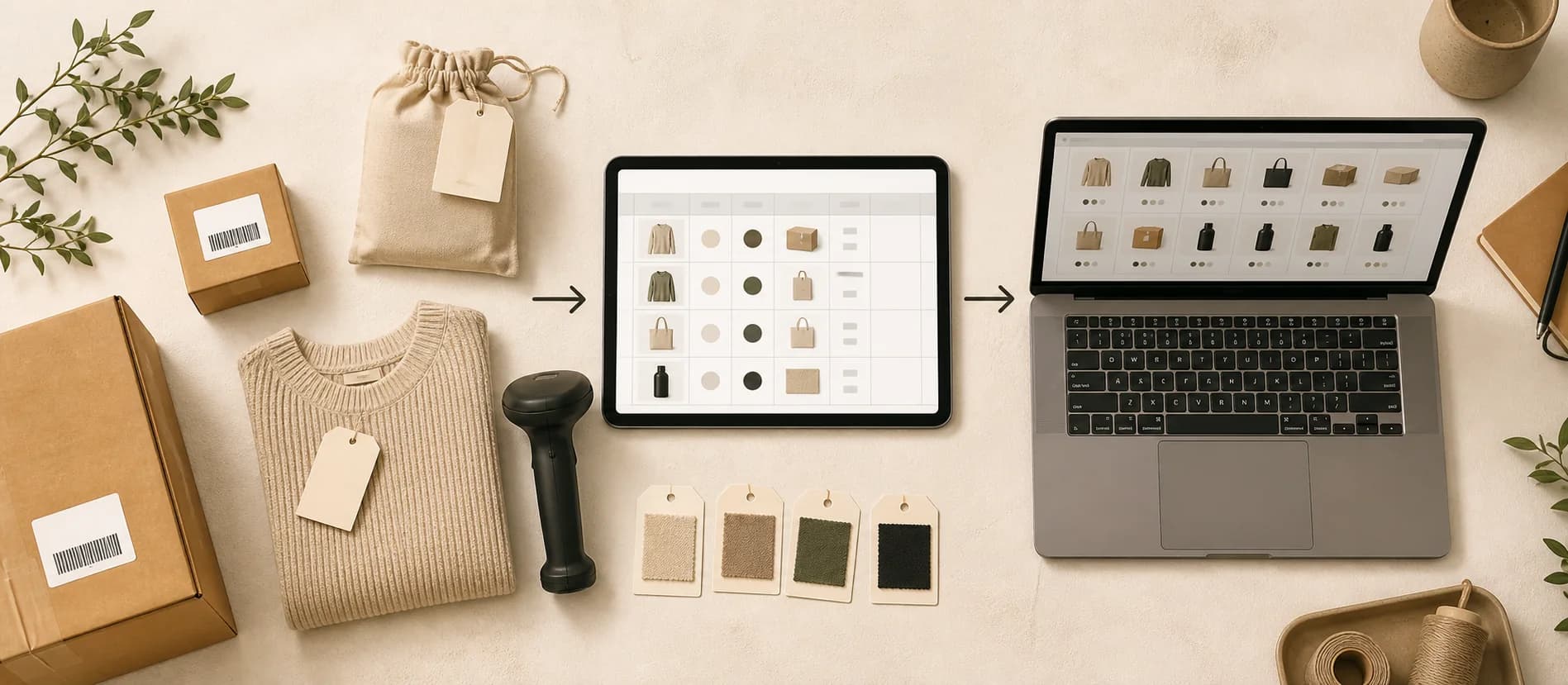
Product taxonomy in ecommerce describes where a product belongs. Identifiers distinguish the particular item being sold. A useful catalog keeps those decisions connected through a product record while giving each field its own evidence and owner. Moving a bottle into a better category does not validate its GTIN, turn a supplier reference into an MPN, or establish which package a barcode identifies.
For an operator reviewing a category change, the practical question is whether the proposed classification describes the same item as the identifier record. Confirm the item, variant, and package first. Then approve the category or hold the unresolved part of the change. Do not let a category edit silently rewrite identity fields. Better taxonomy cannot guarantee channel eligibility, ranking, or acceptance.
This article focuses on that ownership decision. It does not supply a universal category tree, a channel-by-channel identifier matrix, or a replacement for a feed release checklist. The tables and examples below are recommended review practices. The product situations are fictional; they illustrate decisions without implying observed store results.
Separate the hierarchy from the item record
A hierarchy moves from a broad grouping to a more specific grouping. A merchant might organize a catalog as Kitchen → Drinkware → Travel cups. Another might use Outdoor → Hydration → Insulated cups. These are illustrative internal paths, not asserted Google category names. Their usefulness depends on the merchant's assortment and the meaning assigned to each branch.
The category describes a class. It does not distinguish one blue cup from a red cup, a replacement lid from the complete cup, or an individual unit from a case of units. Those differences belong in product attributes, relationships, package definitions, and identifier records. If a classification proposal cannot say which object it describes, it is too early to approve the mapping.
Use a stable internal product reference to connect the decisions. Keep the category path in a classification field and keep identifier evidence beside the relevant sellable item. If a navigation team renames Drinkware to Cups and Bottles, the name change should not by itself cause the item to acquire a new commercial identifier. Conversely, a supplier's corrected identifier should not automatically move the item to another category.
The short GTIN answer explains identifier scope. For this review, the essential distinction is simpler: one field says what kind of thing it is, and another helps establish which thing it is. Both can be wrong independently. A neat category tree with unsupported identifiers remains an unreliable product record.
Assign an owner to every decision
Category ownership should include authority to explain why an item belongs in a branch. It should not grant authority to invent manufacturer information. In a small store, one person may carry both responsibilities, but the evidence still needs to remain separate. A decision made while arranging navigation is not automatically an identifier decision.
| Record or field | Question it answers | Suggested accountable owner | Evidence to request |
|---|---|---|---|
| Internal category | Where does this item fit in our assortment? | Catalog or merchandising owner | Category definition and the item's actual function |
| Navigation collection | Where should shoppers encounter it? | Merchandising owner | Intended shopping journey and collection criteria |
| Destination category mapping | How does our classification translate to this destination? | Feed mapping owner | Named destination field, current specification, mapping rationale |
| SKU | Which internal sellable record are we managing? | Inventory or catalog operations | Approved item master and historical record |
| GTIN | Which trade item does the assigned value identify? | Product-data owner with brand or supplier evidence | Matching product, variant, and packaging documentation |
| MPN and brand | Which manufacturer's part and brand are represented? | Product-data owner | Manufacturer or verified supplier documentation |
| Variant attributes | What distinguishes this version? | Product owner | Approved color, size, capacity, or configuration facts |
| Package definition | What exactly does the customer receive? | Product and fulfillment owners | Unit count, included components, and relevant packaging record |
Treat this table as a starting responsibility map. Replace role names with actual people or teams. An entry such as “the feed app” identifies a system, not someone who can decide between conflicting sources. The mapping owner should be able to point to the person authorized to resolve a disputed classification.
For example, merchandising may approve a new Travel Cups branch while purchasing is still confirming whether a supplier's label refers to one cup or a boxed pair. The two decisions can be tracked separately. Classification can be ready for review while the affected sellable record remains held for identity confirmation. Avoid describing the whole product as approved when only one field has been settled.
Keep feed category attributes in their own lane
Google's product data specification distinguishes google_product_category, which uses Google's taxonomy, from the merchant-defined product_type. It also lists product identifiers separately. Read the current field guidance before deciding how your internal hierarchy should populate either category attribute. A store navigation label is not automatically a valid destination category value. Google product data specification.
Build a mapping record that names both ends of the transformation. “Drinkware goes to shopping” is too vague. Record the source field, internal category reference, destination attribute, chosen destination value, rule version, and rationale. Keep the destination value out of the internal category name unless that deliberate design has been approved. Otherwise an external taxonomy change can accidentally rename the store's own assortment structure.
Also distinguish a source classification from an output override. An override may be justified for a particular destination without becoming the master category for every system. Give the exception a reason and a review owner. A rule that was created for one accessory should not become the default for all products whose title contains the same word.
Do not encode identifier substitutions into a category rule. A transformation such as “all travel cups receive this barcode” is an identity error disguised as classification. Even a narrower rule can be unsafe if it copies a family-level value to every sellable record. Review the exact fields a rule may change, and keep identity fields outside its output unless separately supported and approved.
The product schema versus product feed answer is useful when the same discussion includes website markup. A category change in a feed does not establish that the page's product data agrees. Treat each consumer as a separate readback surface rather than assuming one edit has synchronized everything.
Identify the object before deciding the category
Start a disputed classification with a plain sentence: “This record sells one insulated cup with one fitted lid.” That sentence establishes the object being discussed. It is more useful than a category name alone because it exposes uncertainty about included components, unit count, or intended function before the reviewer chooses a branch.
Next compare that description with the product master, packaging evidence, supplier reference, and selected variant. A title that says Cup may conceal a replacement lid. A photograph may show several objects while the order contains only one. The classification owner does not need to solve every operational problem, but must avoid making a category decision about the wrong object.
GTINs identify trade items within the GS1 standards framework. The standards reference is the place to resolve identification context, not an internal category tree. Consult the appropriate brand or standards evidence when the sellable configuration is uncertain. GS1 Global Trade Item Number.
Google's guidance on finding a GTIN points to the product or packaging and to the manufacturer when the value cannot be found. Use that as a retrieval path for an existing identifier. It does not make a number copied from a similar product suitable for the item under review. Find a GTIN.
Maintain a visible distinction between missing evidence and confirmed absence. “Supplier has not replied” is a pending investigation. It is not a conclusion that the item has no identifier. A classification reviewer should record that dependency and hand it to the identifier owner instead of filling the gap with a category code, SKU, or plausible-looking number.
Product examples: what can share a category?
Consider a fictional merchant selling an insulated cup, two color versions, a replacement lid, and a boxed pair. The example does not assign any commercial GTINs or official taxonomy codes. It shows how a common category decision can coexist with separate item evidence.
| Illustrative item | Category judgment to make | Identity judgment to keep separate | Appropriate hold when unclear |
|---|---|---|---|
| Blue cup, one unit | Does the chosen branch describe the complete cup? | Does the source identify this color and unit? | Hold its identity changes until the exact record is confirmed |
| Red cup, one unit | May use the same internal branch as the blue cup | Do not copy the blue item's identifier as a shortcut | Hold copied or unsupported identifier values |
| Replacement lid | Classify the accessory being sold, not the pictured cup | Confirm the manufacturer's reference for the lid | Hold mapping if the object itself is uncertain |
| Boxed pair of cups | Decide how the assortment treats the packaged offer | Confirm package quantity and identifier applicability | Hold if the evidence describes only a single cup |
| Cup and cleaning brush set | Review the actual contents and merchandising definition | Establish the set's approved product record | Hold if component records are being mistaken for set evidence |
The blue and red cups may belong to the same internal branch because category membership is not a uniqueness claim. Their shared classification tells the operator little about whether their identifier records are correct. Preserve the distinction even if the platform stores the variants beneath one parent product.
The replacement lid exposes another failure mode. A title-based mapping rule might see the word Cup and assign the complete-product category. Before expanding the rule, ask what the customer buys. The correct remedy may be a more precise source classification or a documented accessory exception. It is not to reuse the complete cup's GTIN so that the output appears internally consistent.
The boxed pair requires a package review. If the only evidence describes a single unit, the reviewer should not extrapolate a value for the pair. Confirm the configuration with the product-data owner. GS1 Canada's explanation includes packaging-level identification context; use the relevant standards and supplier records to resolve the actual case. GS1 Canada GTIN overview.
For the cup and brush set, write down whether the merchant is selling one defined set or merely displaying related items together. This is a fact-finding step, not a universal instruction to allocate a new identifier. The classification decision follows the confirmed offer, and the identification decision follows the applicable verified record. Neither should be inferred from the layout of a photograph.
Establish a source of truth by field
A single source of truth should mean that each field has an approved authority and a known route into the catalog. It does not require pretending that one file knows everything. Merchandising can own internal categories while the manufacturer supplies part references and fulfillment confirms package contents. The catalog record brings those approved decisions together.
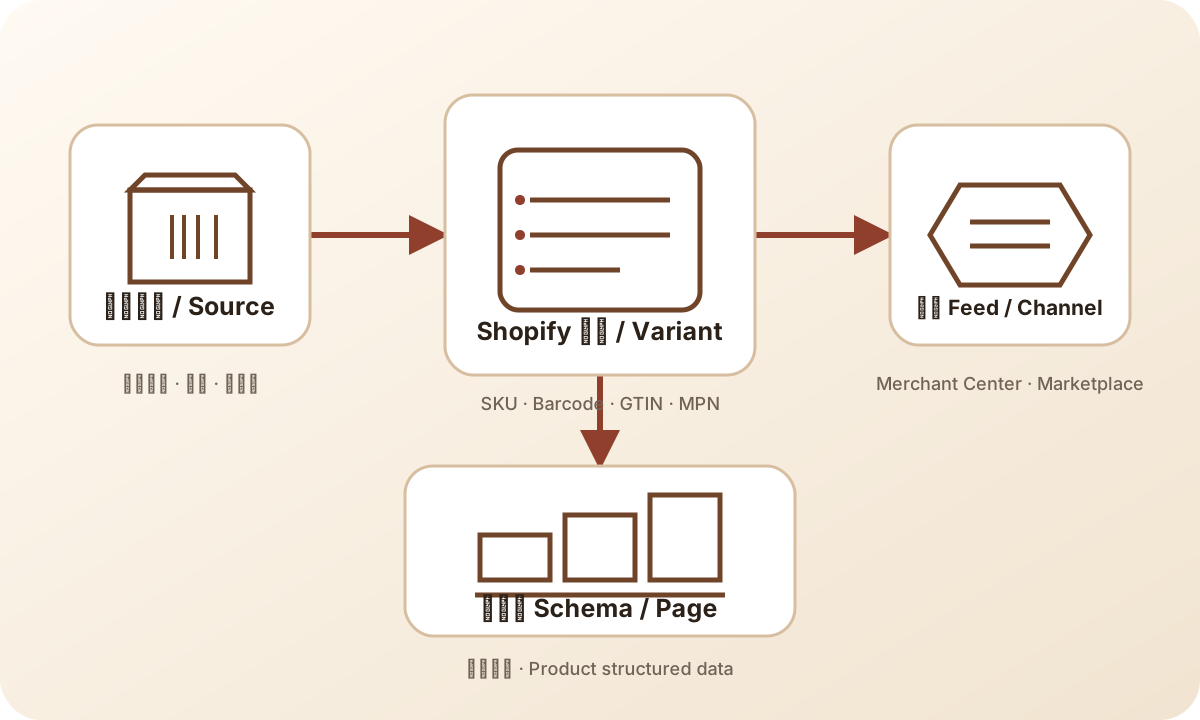
The diagram shows the shared product-data route. It is not a taxonomy code list. Use it to locate where evidence enters the record and where the output is consumed. For a category review, add the classification source and mapping rule to that route while preserving the separate source of each identifier.
Record disagreements rather than hiding them through precedence alone. Suppose a supplier spreadsheet says “two cups” while the approved product page and warehouse record say “one cup.” Choosing the newest file without investigating may propagate an incorrect package definition. Mark the contradiction, name the resolver, and keep the affected change pending until there is an agreed description of the item.
It is also useful to distinguish the raw supplier label from the approved internal category. A vendor's broad label can be preserved for traceability while the merchant assigns a more useful internal branch. Keeping both allows a future reviewer to understand the transformation without assuming the supplier used the merchant's definitions.
For a full operating method, continue with the product-data ownership lesson. This blog's narrower recommendation is to make each classification decision traceable to the same sellable record as its identifiers. The aim is a reviewable decision, not a claim that a particular software architecture is mandatory.
Make mapping rules reviewable
Give a category rule a readable purpose. “Replacement lids follow the accessory classification confirmed by the catalog owner” is easier to challenge than an unexplained list of conditions. Store the actual selection criteria alongside that purpose. A reviewer should be able to tell whether the rule targets an approved category reference, a supplier label, or a fragile text match.
State the precedence between the default mapping and exceptions. If both match an item, the operator needs to know which value will be emitted and why. Avoid a situation where a manual fix looks correct in the editor but the next scheduled synchronization quietly replaces it. The person approving the mapping should review the persisted rule and a resulting record, not just an unsaved preview.
Version the rule when its meaning changes. A spelling correction to a display label may need a different review from a change that moves accessories into a complete-product branch. Keep the old and proposed mappings available so a reviewer can compare their scope. Record the exact affected item set instead of relying on a recollection that the change was small.
Include negative examples. If a rule is intended for complete cups, show that the replacement lid is excluded. If the rule targets a particular internal branch, show a neighboring branch that should retain its current mapping. These examples test the decision boundary; they do not establish that every item in the catalog is correct.
Avoid using completion percentages as a substitute for evidence. A report saying that every item has a category measures field population. It does not demonstrate accurate classification, valid identifiers, or suitable packaging records. Keep “mapped,” “reviewed,” and “identity confirmed” as separate observations with definitions the team can explain.
Decide what to hold
A hold should identify the smallest affected item set and the exact unanswered question. It should not become an indefinite note saying “catalog problem.” If the uncertainty concerns a replacement lid's classification, describe whether the proposed mapping alone is held or whether the underlying item is too ambiguous to submit at all.
| Observation | Recommended decision | Evidence that can resolve it |
|---|---|---|
| Internal branch has no written meaning | Hold the mapping proposal | Category definition and accountable owner |
| Two rules emit different destination categories | Hold the conflicting rule scope | Approved precedence and resulting item output |
| Supplier label and package description disagree | Hold changes dependent on item identity | Confirmed contents and matching source record |
| Same identifier was copied across a category | Hold those identifier changes | Item-specific assignment evidence |
| Category is supported but identifier evidence is pending | Record separate states | Identifier owner's resolution for the affected items |
| A mapping edit unexpectedly changes SKU or GTIN | Stop that transformation | Field-level explanation and separately approved identity change |
Preserve the last reviewed mapping as a comparison point, but do not assume an old value is safe merely because it existed before. If the new investigation reveals that the current record is also wrong, the owner must decide how to contain that item. Returning to a known version and proving factual correctness are different tasks.
Give the hold a review trigger: a supplier response, an approved category definition, or a corrected mapping rule. Name who checks the evidence when it arrives. Without that trigger, another operator may interpret silence as approval and push the same ambiguous record through a later batch.
The feed debugging lesson covers tracing disagreements across systems. Use it when the approved source and processed output differ. Keep this classification review focused on the particular rule and item relationship that produced the disagreement.
A compact category decision record
Use the following fictional review record as a template. The statuses describe proposed internal workflow states, not a real Merchant Center result. No field in this example is a commercial identifier.
| Field | Illustrative entry |
|---|---|
| Item scope | Replacement lid for the insulated cup family |
| Object sold | One lid; cup excluded |
| Current classification | Included by a title match for Cup |
| Proposed classification | Approved internal accessory branch; destination mapping awaiting review |
| Reason | The rule describes the parent cup rather than the item sold |
| Source | Product owner's confirmed item description and packaging record |
| Mapping owner | Named catalog operator |
| Identifier owner | Named product-data reviewer |
| Identifier decision | No changes authorized by this category proposal |
| Rule scope | Exact lid records; complete cups excluded |
| Hold | Destination value remains pending until its specification is checked |
| Review evidence | Before and proposed values, rule version, and affected record list |
Add a date and reviewer identity when the decision actually occurs. Do not prefill an approval date or channel outcome. The record should let a colleague reconstruct the reasoning without searching through several chats, but it need not reproduce an entire release log. Link to the broader release record if one exists.
After an approved change is applied, compare the stored category and identifier fields for the same items. Confirm that the intended mapping took effect and that unrelated identity fields did not change. Record the surface inspected and the limit of that inspection. A local export check demonstrates the export; a destination readback demonstrates the processed destination record at that time.
Review checklist for the catalog owner
Use this checklist when a category proposal crosses into product identity. It deliberately stops short of a complete feed submission process. The existing product feed quality checklist covers the broader title, identifier, price, and availability review.
- Describe the exact object sold, including variant and package contents.
- Name the internal category owner and the identifier evidence owner.
- Separate internal hierarchy, navigation collections, and destination category attributes.
- Record the source and destination fields, mapping version, and exception precedence.
- Confirm that category rules do not copy or invent GTIN, SKU, MPN, or brand values.
- Include an accessory or neighboring branch that the rule should exclude.
- Mark contradictory supplier or packaging evidence as unresolved.
- Define the exact held scope, resolver, and event that permits another review.
- Keep before and proposed values with the reason for the change.
- Read back the affected records after application and describe what was actually verified.
If the outstanding question is whether an existing GTIN has a valid structure, the GTIN tool can assist with mechanical format and check-digit checks. It does not allocate commercial identifiers, verify brand ownership, or guarantee channel acceptance. Do not use a test value from a tool to make a taxonomy review appear complete.
For the wider identifier context, read GTIN, UPC, and EAN in Shopify. The GTIN and product-data topic path separates the related definition, tool, and operating questions so that a category review can stay focused.
Frequently asked questions
Can changing a product category fix an incorrect GTIN?
No. A category change can correct classification, but it does not verify or replace the item's assigned identifier. Resolve the GTIN against the exact product and package evidence, with its own owner and review decision.
Can different variants share a category?
Yes, an internal category can group related variants. Shared category membership does not justify copying identifiers between variants. Review the identifier evidence for each affected sellable record.
Is product type the same as a destination category?
Do not assume equivalence. Separate the merchant's internal classification from the destination's category field and document the mapping. For Google, check the current guidance for product_type and google_product_category before choosing values.
What should happen when supplier evidence conflicts?
Hold the changes that depend on the disputed item description or identifier. Record both sources, the affected items, the resolver, and the evidence needed to resume review. Do not treat missing confirmation as approval.
Sources and reading boundaries
- GS1 Global Trade Item Number: trade-item identification standards context.
- GS1 Canada GTIN overview: packaging-level identification context.
- Google Merchant Center product data specification: category and identifier field definitions; consult current field-level requirements for the named destination.
- Google Merchant Center: Find a GTIN: locating an existing identifier through product, packaging, and manufacturer evidence.
The ownership tables, review records, holds, and fictional product examples are editorial recommendations. They are not platform mandates or evidence of accepted products, search rankings, or improved commercial outcomes.