
A GTIN-14 can appear when a supplier identifies a packaging level, when a warehouse receives a case, or when a product system exchanges identifiers in a fourteen-digit field. Before putting that number into an ecommerce offer, establish which trade item it identifies and whether that is what the buyer receives. Fourteen visible digits alone do not tell you the pack quantity, prove commercial assignment, or make a carton identifier suitable for a single-unit listing.
The useful question is therefore: does this identifier belong to the exact package being ordered, priced, and fulfilled? This article focuses on that package-level decision. It does not allocate identifiers, provide a barcode printing specification, or promise channel approval. The examples below are proposed operating practices and hypothetical records, not evidence of a merchant's results.
Start with the package, then inspect the number
An ecommerce team may receive a supplier spreadsheet with columns named barcode, product code, case code, and carton quantity. Those headings are clues, not a reliable mapping contract. Ask the supplier what one row represents. A row describing twelve bottles can be a purchasing record for a case, while the shop sells each bottle individually. Both records can be correct in their own setting and still create a wrong listing when copied across without the packaging relationship.
GS1 Canada describes GTINs as identifiers for trade items and discusses packaging levels including inners, cases, and pallets. It also separates GTIN types from the barcode symbologies that carry them. That distinction is enough to reject a common shortcut: a number photographed on outer packaging is not automatically the identifier for every item inside it. GS1 Canada: Global Trade Item Numbers
Begin a package decision with four plain descriptions: the item bought from the supplier, the unit stored in inventory, the item advertised, and the unit dispatched to the customer. Where those descriptions differ, record the conversion or relationship explicitly. Do not let a shared product name stand in for it. “Blue bottle” could describe an individual bottle, a retail pair, or a replenishment case containing several pairs.
If you only need the general definition, the GTIN answer is the shorter starting point. Here the task is narrower: deciding whether a fourteen-digit value should remain on a logistics record, describe a sellable pack, or wait for better evidence.
Where fourteen digits enter the workflow
Three entry points deserve separate attention. First, a supplier may provide a GTIN for a grouping of identical products. Second, a receiving process may scan a barcode on a package rather than on the individual product. Third, an integration may store a shorter GTIN in a fixed fourteen-character representation by adding leading zeroes. These situations can look similar in a spreadsheet while requiring different decisions.
Treat the third situation as a representation question that needs the source-system contract. A padded representation of an existing identifier does not, by itself, establish a new package identity. Preserve both the original value and the transformation record until the team can explain the relationship. A fourteen-character database column is not evidence that the supplier assigned a new case GTIN.
The following table is an operating aid, not a universal allocation rule. It tells you what evidence to request before deciding where the value belongs.
| Where the value appears | Question to resolve | Evidence to compare | Safe state while unresolved |
|---|---|---|---|
| Supplier case list | Does the row describe a case or an individual item? | Package description, contained quantity, assignment record | Retain as an unconfirmed case candidate |
| Scan of outer packaging | Which package did the scanner read? | Photo showing label and full package, receiving record | Keep scan context attached |
| Fourteen-character system export | Was the value padded from a shorter identifier? | Original field and documented transformation | Preserve original and normalized values |
| Manufacturer multipack listing | Is the identical pack being offered? | Pack contents, variant, quantity, manufacturer record | Hold mapping if any attribute disagrees |
| Single-unit storefront offer | Is there evidence for the individual unit? | Unit packaging and corresponding product record | Do not substitute the case candidate |
This approach also helps when several departments use the word “unit.” Purchasing may mean a case, finance may mean an invoice line, and fulfillment may mean one sellable item. Replace the ambiguous word in the disputed record with a specific phrase before asking anyone to approve the mapping.
GTIN-14 and ITF-14 answer different questions
GTIN-14 names an identifier format. ITF-14 names a barcode representation. The data and the printed carrier need separate decisions. GS1 Canada lists ITF-14 among the symbologies that can carry multiple GTIN types, alongside other GS1 barcode representations. An ITF-14 label therefore should not be treated as independent proof of the package's commercial identity. GS1 Canada: GTIN types and encoding types
Google's introductory guide uses ITF-14 when discussing fourteen-digit identifiers for multipacks, with shipping boxes as an example. Read this as guidance for finding a number on packaging, not as a statement that every fourteen-digit value identifies a shipping carton. The guide also directs merchants to the manufacturer when they cannot find the product identifier. Google Merchant Center: Find a GTIN
For a data-mapping task, record what was read and where it was read. For a label-production task, the responsible packaging specialist also needs the applicable symbol, dimensions, print quality, and scanning environment requirements. This article does not supply those specifications. A successful scan proves that a particular reader obtained data from that label in that test; it does not settle allocation, package correspondence, or suitability for another scanning environment.
Keep barcode images out of fields that expect the identifier string. Conversely, a text field containing fourteen digits does not provide a print-ready barcode asset. A support request saying “the barcode works” is incomplete unless it says whether “works” means the image scans, the check digit passes, or the downstream product record matches the intended package.
Read structure without guessing package meaning
A GTIN-14 has a check digit at the end. GS1 Canada's illustrated structure also identifies an indicator position. Neither that position nor the total length gives a merchant permission to infer the contents of an unknown package. In particular, do not read a leading digit as “this many units in the box.” Obtain the quantity from the package record. GS1 Canada: How GTINs are formed
In practical review, the full identifier is the lookup value. Avoid carving it into a presumed fixed company-prefix length and an item code unless the relevant assignment information supports that interpretation. A supplier's internal SKU may resemble part of a GTIN by coincidence or by its own numbering convention. That resemblance is not a safe join key between the unit and the case.
There is a separate issue when a shorter GTIN appears with leading zeroes in a fourteen-digit storage representation. Confirm the originating value and the integration rule before labeling it GTIN-14 in the business record. Teams can distinguish “stored length: fourteen” from “source identifier type” without inventing a new number. If the source application does not expose that distinction, capture the uncertainty in the review notes rather than silently deciding it.
Do not add a nonzero leading digit and recalculate the ending digit to create a commercial case identity. Even when arithmetic produces a structurally plausible value, the act has not established authorized assignment. Ask the brand owner or responsible GS1 member organization about the appropriate allocation process. An ecommerce data editor should not become the allocator merely because a spreadsheet formula is available.
What a check-digit result establishes
The check digit is a mechanical consistency check on the supplied digits. It is useful for finding certain transcription problems. The Ecomwith GTIN tool supports structure and check-digit work for development and feed QA. Its result must stay attached to that limited purpose: it does not allocate a commercial GTIN, establish ownership, identify the correct packaging level, or guarantee Merchant Center acceptance.
Run a mechanical check on the exact source string after separating obvious presentation characters according to the field's documented rules. Preserve the original capture so a reviewer can see what changed. If the number fails, compare it with the supplier's authoritative record or a clearer package image. Do not “repair” the last digit merely to obtain a pass. The error might be in an earlier digit, or the entire number might belong to a different package.
A pass and a failure also have different operating consequences. A failure gives you a reason to question the transcription or source data. A pass removes that particular objection; it does not supply missing product evidence. A case identifier can pass perfectly and still be wrong for the bottle sold on the storefront. Label the result “format/check digit passed,” not “product verified.”
For test fixtures, keep synthetic values clearly separated from production product data. A demonstration number is useful for exercising validation behavior, but copying it into a sellable offer turns a test artifact into an unsupported identity claim. This article uses symbolic labels in its worked example so there is no plausible commercial GTIN for a reader to reuse accidentally.
Model the packaging relationship explicitly
A useful working model has a product record, a package record, and an offer record. These are conceptual responsibilities; they do not require installing a new system or restructuring every database. The product record describes the underlying variant. The package record identifies the exact grouping. The offer record says which grouping the customer buys for the displayed price.
For a small shop, a controlled table can express those distinctions. Keep the supplier's package identifier next to a human-readable description, contained item reference, and contained quantity. Link the storefront variant to the package it actually sells. The purpose is to make an incorrect substitution visible before a connector copies a generic barcode column into customer-facing data.
| Proposed field | What it should explain | Example using symbolic values |
|---|---|---|
| Product variant reference | Which underlying product is involved | Blue bottle, standard size |
| Package reference | Which defined grouping is involved | Sealed case of twelve blue bottles |
| Package GTIN candidate | Identifier under review, preserved as text | CASE-GTIN, symbolic placeholder |
| Contained item reference | What is inside the grouping | UNIT-RECORD |
| Contained quantity | How many of that item the grouping contains | Twelve |
| Sellable package reference | What one ordered offer delivers | UNIT-RECORD or CASE-RECORD |
| Evidence reference | Why the mapping is believed | Supplier record plus matching label photo |
Do not use the candidate field as a destination-ready value while its evidence is incomplete. A visible “pending package confirmation” state is more useful than a blank comment next to a populated identifier. It allows purchasing to retain the supplier information while preventing an unreviewed case value from flowing into every consumer variant.
The product-data ownership lesson covers the broader responsibility system. This article only needs the part that resolves the package dispute: who can confirm the contents and identifier, and who can explain the actual sellable offer. The two answers may come from different people.
A hypothetical bottle-and-case decision
Suppose a merchant buys sealed cases containing twelve identical blue bottles and sells bottles individually online. A supplier sheet contains a fourteen-digit value labeled “case barcode.” The warehouse scans the same value on the outer case. The storefront has a single-bottle variant with an empty identifier field. These observations establish a case candidate and a missing unit value; they do not establish that the candidate belongs in the storefront field.
The proposed next step is to request the unit-level product record and a label image for the bottle. Keep the case candidate attached to the receiving package. Record that one case contains twelve units only when the supplied package evidence confirms it. There is no need to invent a replacement number or delete the useful receiving information while this request is pending.
Now suppose the merchant wants a second offer that sells the unopened case. The review changes because the customer would receive that exact grouping. Compare the supplier's case definition with the proposed offer: same bottle variant, same count, same packaging configuration. Then review the destination's current handling for that offer. The existence of a matching case record supports the package mapping, but it is not a promise that a particular channel will accept the submission.
Finally, suppose the merchant makes its own six-bottle bundle from the twelve-bottle case. The supplier's case candidate does not become a six-bottle identifier by division. The merchant needs to establish the appropriate identity and channel treatment for the new offer. Keep that decision open until the responsible source confirms it. A warehouse conversion of twelve bottles into two groups of six is an inventory operation, not proof of a new authorized GTIN assignment.
These branches all begin with the same supplier value. The deciding evidence is the package being offered, not which row has a populated barcode field. No number is provided here, and none of the branches claims a real allocation, approved listing, or fulfillment outcome.
Follow the value through logistics and ecommerce
When the package relationship is clear, follow the selected value through the systems that actually consume it. Start with the supplier record, then the receiving or inventory record, the storefront variant, and the outgoing offer. Include page structured data if the site publishes it. Inspect one named package and one named offer before generalizing a mapping rule across the catalog.
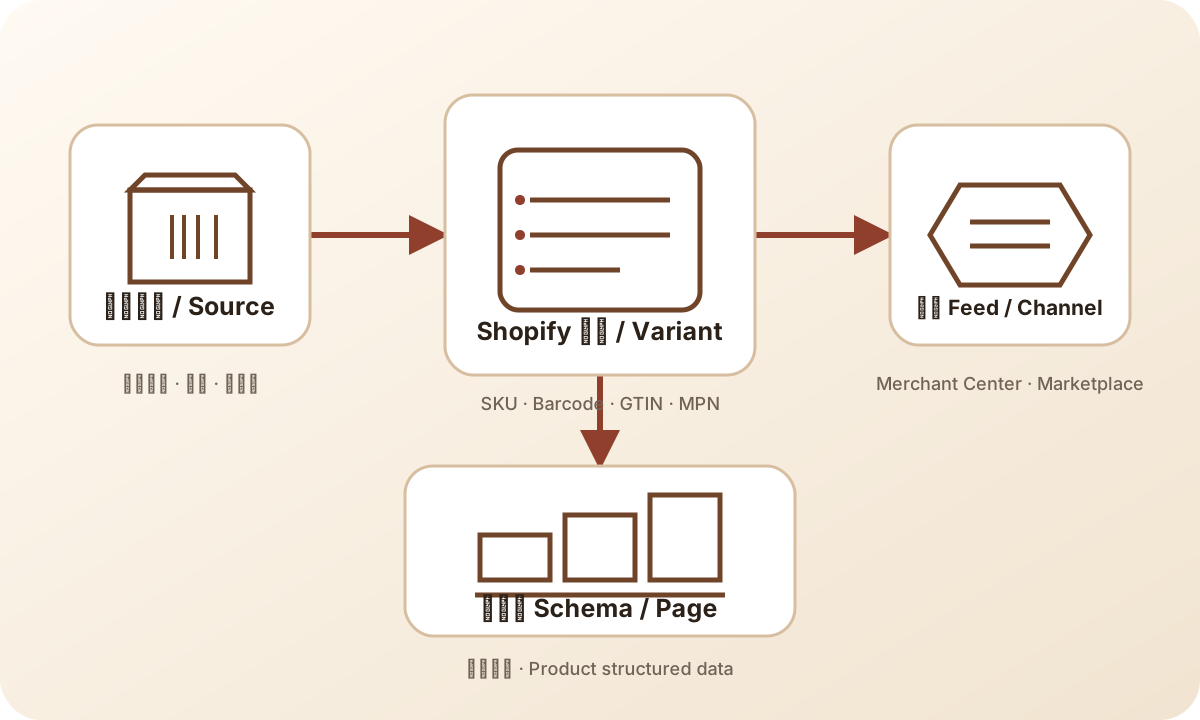
The diagram shows the existing product-data flow. For GTIN-14 work, place the package decision before the storefront variant step. A warehouse may legitimately keep a case identifier while the storefront uses the confirmed unit identifier. Agreement means each system represents its intended item correctly; it does not mean every field must contain the same string.
Ask the connector owner which source field populates the outgoing identifier and whether there are fallback rules. A generic rule that selects the first nonempty barcode can quietly choose a case value when the unit value is missing. In a proposed correction, bind the selection to the sellable package rather than to availability of data. Test that the unresolved unit remains unresolved instead of inheriting its parent's identifier.
Also separate the product identifier from operational identifiers such as an order reference, tracking number, or internal warehouse location. Their presence on the same label or document does not make them interchangeable. The product schema versus product feed answer explains why page markup and destination data deserve separate inspection even when they originate from the same catalog.
Preserve the string during spreadsheet and API handling
Treat identifiers as text throughout the transfer. Spreadsheet formatting, numeric conversion, and casual trimming can change what a reviewer sees or exports. Keep a source column that retains the captured digits exactly, and use a separate comparison column if a documented normalization is needed. A visual display format is not enough evidence that the exported value preserved the original string.
For a proposed connector check, compare the raw source value, the internal stored value, and the serialized outgoing value. Include any leading zeroes in that comparison. Where two systems deliberately use different valid representations, document the exact relationship and confirm that the destination contract supports it. Do not create a global rule that strips leading zeroes from every identifier type.
Avoid deduplicating packages solely because normalized strings look similar. First establish that the values are representations of the same identity, rather than distinct assignments or a transcription error. Likewise, a change from one text length to another should not automatically trigger a new product record. The review needs the source explanation for the change.
If a warehouse export and a catalog export disagree, compare their package descriptions before correcting either file. The warehouse may be reporting cases while the catalog reports units. If both claim to describe the same package and still disagree, preserve both records and ask the responsible source to resolve the conflict. A majority vote among duplicated spreadsheets is not evidence of correctness.
Use a specific hold, with evidence that can resolve it
“Needs checking” leaves the next person guessing. A useful hold names the exact package, the proposed destination, the missing evidence, and the condition for reconsideration. For example: “Hold the unit offer mapping because only a case label is available; resume after the manufacturer record identifies the single bottle.” That statement is narrow enough to act on without stopping unrelated products.
| Observation | Proposed action | Evidence needed to reconsider |
|---|---|---|
| Case value offered for a single unit | Hold that mapping | Confirmed unit record or correction of the offer definition |
| Check digit fails | Compare with source; do not invent a repair | Authoritative corrected string and matching package |
| Two supplier documents conflict | Retain both versions and escalate | Source confirmation of the applicable package and version |
| Value was padded without a recorded rule | Hold the transformation | Originating identifier and supported representation contract |
| Retailer assembled a different bundle | Keep assignment undecided | Appropriate identity decision for that new grouping |
| Mapping is supported but submission is pending | Keep channel state pending | Same-offer processed result at the destination |
Set the review scope to the affected package and offer. A hold on the case-to-unit mapping does not imply that all purchasing records must be erased. Conversely, an unchanged warehouse scan does not justify continuing an unsupported customer-facing mapping. Preserve useful evidence and restrict the uncertain action.
For recurring disagreement, move the responsibility question into the feed debugging lesson. For a complete pre-submission process, use identifier checks before submission. The package decision should feed those workflows rather than reproduce their whole release checklist here.
A package-level review checklist
Use this checklist when a GTIN-14 candidate first appears or when the proposed sellable grouping changes. It is a decision aid; it does not certify GS1 assignment or replace destination requirements.
- Describe exactly what one customer order line delivers, including the variant and quantity.
- Identify the package on which the candidate was observed and keep the label in context.
- Obtain the source record that links the identifier to that package.
- Separate a native package assignment from a shorter identifier stored in a fourteen-digit representation.
- Preserve the identifier as text and inspect the actual exported value.
- Run structure and check-digit checks without changing digits to force a pass.
- Confirm the relationship between receiving package, contained item, and sellable package.
- Check the connector's source selection and fallback behavior for the named offer.
- Keep commercial assignment, package correspondence, and destination processing as separate evidence states.
- Hold the specific uncertain mapping with a named missing record and a clear condition for review.
The resulting decision can be short: use the supported unit mapping, retain the supported case mapping, or hold the proposed mapping. Attach the evidence that distinguishes those options. A long checklist with no resolved package description is less useful than a clear record showing which item the customer will receive.
For wider context on related identifier names, continue to GTIN, UPC, and EAN in Shopify. The GTIN and product-data topic path collects the adjacent questions without turning this package-level article into a general course.
Frequently asked questions
Does every GTIN-14 identify a shipping carton?
No. Confirm the identified trade item and packaging level from its source record. Fourteen visible digits can also result from a system representation of a shorter identifier. Length and the location of a label do not independently establish the package definition.
Are GTIN-14 and ITF-14 the same thing?
No. GTIN-14 refers to an identifier format; ITF-14 refers to a barcode symbology. A scan or barcode image does not establish commercial assignment, package correspondence, or channel acceptance.
Can I use a case GTIN when I sell one item from the case?
Do not substitute it without evidence for the exact sellable item. Request the unit record and keep the case identifier attached to its package. A populated supplier field is not a reason to map the wrong packaging level.
Does a valid check digit prove I can use the number?
No. It establishes only mechanical consistency of the supplied digits. Authorized assignment, the matching package, and the destination's processed result need separate evidence. Do not change a digit or generate a test value to fill a commercial gap.
Sources and scope
- GS1: Global Trade Item Number supplies the standards context in the project evidence packet.
- GS1 Canada: Global Trade Item Numbers supports packaging levels, structure, check-digit terminology, and the distinction between identifiers and barcode carriers.
- Google Merchant Center: Find a GTIN supports locating a product's identifier and asking its manufacturer when it is missing.
The tables, symbolic example, and hold wording are editorial operating proposals. They do not document a commercial allocation, a merchant implementation, or an accepted channel submission.