
To verify a GTIN before using it, trace the number to an accountable product source, match it to the exact variant and package you sell, and then check its format and check digit. Record what each check established. A number that passes a calculator still needs assignment evidence, and a number supported by product records still needs to be processed under the destination channel's rules. Neither result guarantees acceptance.
This article helps a merchant decide whether one candidate identifier has enough evidence to enter a product record. It applies when a supplier sends a spreadsheet, a reseller copies a number from packaging, or a brand prepares its own catalog. It does not allocate identifiers or certify products. The practical output is a documented decision: supported for this item, held for a specific discrepancy, or still awaiting evidence.
Start with the item you intend to sell
Before opening a lookup or checker, write a short identity statement. Include the brand, manufacturer model or part number where available, variant attributes, quantity, and packaging configuration. A blue 750 ml bottle sold individually is a different review target from a carton containing six bottles. A parent product name such as "travel bottle" is too broad to establish either target.
Use the actual offer and fulfillment item together. A listing may display one bottle while the warehouse picks a multipack. If those descriptions disagree, deciding which number looks more plausible will not repair the underlying ambiguity. Ask the product owner to establish what the customer receives. Keep the identifier candidate attached to its original source while that question is resolved.
The GS1 GTIN overview explains the identifier's role in identifying trade items. For this review, the operational consequence is simple: evidence must connect the number to a particular trade item, not merely to a product family or a familiar brand name. The concise GTIN answer covers the terminology if that distinction is new to you.
Do not start by generating a replacement number. You are investigating an existing claim about identity. If the product genuinely needs an identifier assigned, route that question to the accountable brand or the appropriate GS1 organization. A catalog operator should not convert an unresolved source question into a newly invented commercial identifier.
Separate the layers of verification
The following table is a suggested merchant review method. It is not a certification scheme or a list of universal channel requirements. Each row answers a different question, so record separate results rather than one unexplained "valid" flag.
| Layer | Question to answer | Useful evidence | What a passing result does not establish |
|---|---|---|---|
| Product scope | What exact item will be sold? | Variant specification, quantity, package photographs | That any proposed number belongs to it |
| Source and assignment | Who connects this number to this item? | Accountable brand record, manufacturer confirmation, traceable supplier documentation | Destination acceptance |
| Consistency | Do independent product details agree? | Brand, model or MPN, capacity, color, package level | That a similar product is interchangeable |
| Mechanical integrity | Was the number preserved correctly? | Original text, supported length, check-digit result | Allocation, ownership, or product authenticity |
| Destination handling | What did the named channel process? | Current channel guidance and processed item readback | Acceptance in another account or channel |
Keep the source layer ahead of the mechanical layer in the decision. A failed mechanical check can reveal a transcription problem, but a successful one cannot resolve a brand mismatch. Likewise, a channel may retain a submitted value without proving the supplier's assignment claim. Evidence gains meaning from the question it answers.
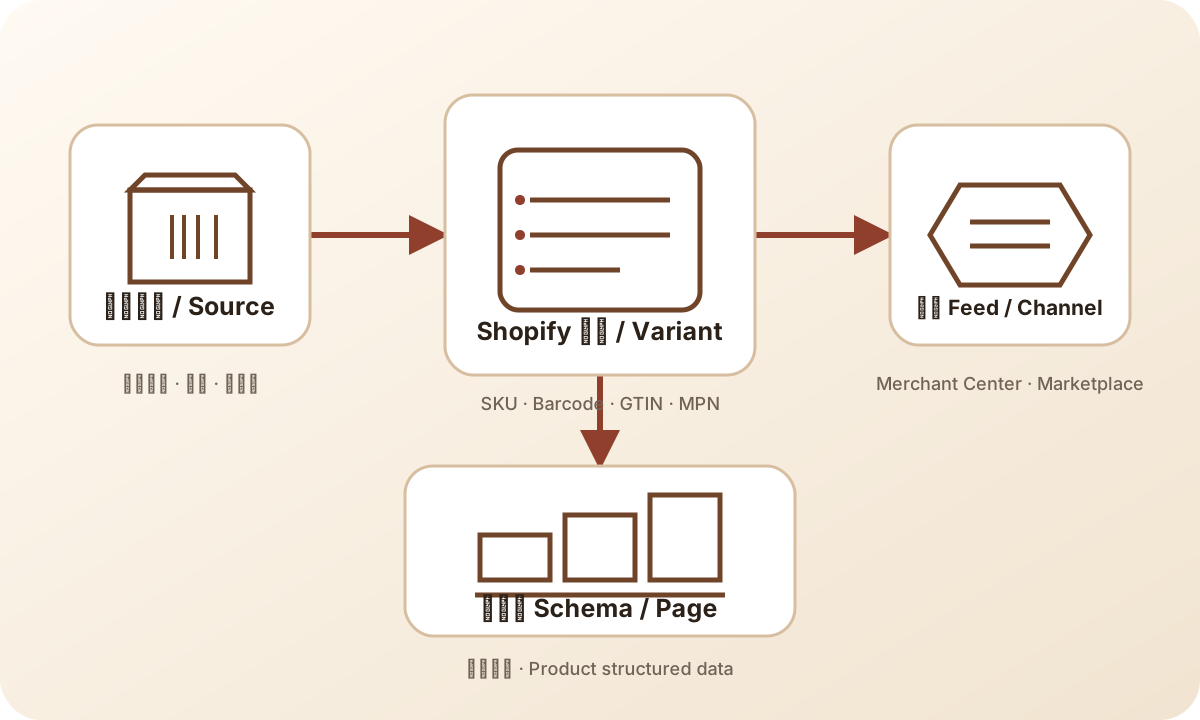
The diagram shows why a value can be consistent across several surfaces and still need source verification. If every downstream surface copied the same unsupported spreadsheet cell, their agreement is evidence of copying, not independent confirmation of product identity.
Ask for a record that connects the number to the product
A useful source record contains more than an isolated barcode column. Request the exact number together with a product description, brand, variant details, package quantity, document date or version, and an accountable contact. If an MPN exists, ask for it in the same record. These details let you test whether the supplier answered the question about your item rather than a nearby catalog entry.
For an existing branded product, begin with the brand or manufacturer documentation available through your legitimate supply relationship. Product packaging can corroborate that documentation. A distributor's spreadsheet can also be useful when its entries are traceable to the underlying product source. Record the distributor's role; do not relabel a reseller's spreadsheet as a brand assignment register.
If an official GS1 verification route is appropriate, follow the route made available by GS1 and preserve what its response actually says. Do not interpret a company match as a complete product match. If a response contains only company information, you still need evidence for variant and package identity. If it contains product information, compare that information with the item you will sell instead of stopping at a positive-looking result.
Public lookup coverage and response detail should not be guessed. A missing result is an unresolved observation, not automatic proof that the product has no GTIN or that the number is fraudulent. Ask the accountable source to explain the gap and obtain the documentation needed for your review. Avoid declaring a specific registry feature or coverage level unless you have checked it directly.
Search-engine results and another seller's listing can supply leads, but they are weak final evidence when you cannot establish where their identifiers came from. Several stores may have copied one incorrect record. Save a conflicting listing only as a discrepancy to investigate. Do not let the number of matching search results outweigh an authoritative product record for the exact package.
Match variant attributes and packaging explicitly
Compare the attributes that make the candidate record specific: model, size or capacity, color where relevant, included accessories, and count. Read the description rather than matching only the first words of a title. A supplier might shorten two variants to the same name in an export, making a row look like a match even though its capacity or included components differ.
Photographs should show enough context to identify the package carrying the barcode. A tightly cropped number cannot tell you whether it came from the individual unit, retail multipack, or outer shipping case. Ask for the product-facing label and the package quantity where those facts are absent. Keep that context beside the candidate value in the review record.
GS1 Canada's GTIN guidance discusses identifiers and packaging levels. Use it to recognize that packaging configuration matters. Do not derive the identifier for one configuration by editing another number or assuming that an outer-case number applies to a single unit. Establish the actual assignment for the configuration you are reviewing.
A change in the offer deserves attention even when the product name stays the same. Adding an accessory, combining units, or switching the fulfilled package can make an earlier review too narrow for the new offer. This article does not decide every allocation rule. When a change raises an assignment question, preserve the old evidence and ask the product owner to resolve the new configuration before extending approval.
Keep marketing differences separate from physical differences. A translated title alone does not describe a new physical item. Conversely, similar translated titles do not prove two regional packages are identical. Compare the documented item and configuration first, then handle language and destination requirements separately.
Preserve the original value before checking it
Store the candidate as text during investigation. Preserve leading zeros and keep the original supplier value available for comparison. Spreadsheet formatting can hide zeros or display long numbers in scientific notation; a screenshot of a shortened display is insufficient to reconstruct the exact identifier. Return to the original record when the underlying text is uncertain.
Create a separate working field if you need to remove display separators for a supported check. Record that transformation rather than silently overwriting the source. The reviewer should be able to explain why the checked value differs from the printed presentation. Do not add digits to reach a preferred length or alter a digit until a calculator reports success.
Use the Ecomwith GTIN tool for its stated structure and check-digit checks. Its result can help identify a malformed or mistyped candidate. It does not allocate a commercial identifier, establish ownership, authenticate the goods, or connect the number to your variant. The source record must do the identity work.
If the tool reports a failure, compare the entered string with the original product evidence. A transcription correction should restore an evidenced value, not construct a new one. If the original evidence itself contains the failing number, send the discrepancy back to the responsible source. Record both the observed failure and the corrected source document when one becomes available.
If the tool passes, write a narrow conclusion such as "structure and check digit passed for the supplied string." Do not change the source-and-assignment status merely because this result is positive. Keeping those fields separate prevents a future colleague from mistaking an arithmetic result for completed commercial verification.
Use brand, MPN, and SKU to investigate disagreements
Brand and manufacturer part number can help connect records that use different display titles. They are corroborating details when the source provides them. Compare the MPN exactly enough to distinguish suffixes, kit variants, and package-specific descriptions. A truncated part number can hide the detail that explains why two seemingly similar records carry different GTINs.
An internal SKU usually helps you find the merchant's row and fulfillment record. It does not become the manufacturer's part number merely because it is unique in your shop. Keep the field names visible when requesting evidence: merchant SKU, supplier item code, manufacturer part number, and GTIN may all refer to related records without being interchangeable values.
When the GTIN agrees but the brand or MPN does not, hold the candidate and investigate. The disagreement may reflect an outdated supplier document, a wrong variant mapping, or a source mistake; those are possible explanations, not findings. Ask for clarification tied to the exact item. Do not pick the explanation that makes the row easiest to publish.
When brand and MPN agree but the GTIN differs, compare package level, document version, and the actual goods. Preserve both candidates and their sources. A reviewer needs to know which document supports each value and why one was chosen. Replacing one value with another without retaining that reasoning makes the next discrepancy harder to resolve.
If identifier terminology is obscuring the discussion, GS1's product-identifier explanation provides the standards context. Use it to align the question, then return to the evidence for your item. A definition does not choose between two conflicting catalog rows.
Adjust the evidence request to your role
A retailer listing an existing product
Ask the supplier for the identifier associated with the exact sellable variant and package. Compare it with the goods you hold or the fulfillment specification you rely on. If the supplier provides only a parent model or an outer-carton code, request the missing level of detail. The retailer's task is to preserve the established identity through its catalog, not create a convenient substitute.
Keep purchase and product evidence related but distinct. An invoice may show a commercial supply relationship while omitting the detailed identifier assignment. A product sheet may identify a model while omitting the pack size. Together they can support investigation, but describe the gaps rather than declaring that any one document automatically completes verification.
A manufacturer or brand maintaining its own catalog
Consult the organization's accountable identifier records and the person responsible for assignment. Match the approved item specification to the planned package and label. If assignment has not been completed, resolve that work through the appropriate process before treating a test number as usable product data. Manufacturing the goods does not make a calculator an allocation service.
Where a contract manufacturer, brand owner, and distributor all participate, identify who can confirm the assignment for the branded trade item. Do not infer responsibility solely from who exported the spreadsheet. The product-data ownership tutorial addresses the broader ownership system; this review only needs the responsible source for the candidate under consideration.
A reseller working with incomplete documentation
Preserve the package evidence and ask your legitimate supplier for clarification. State precisely what is missing: a readable number, variant match, package quantity, or explanation of a conflicting record. That request is more useful than asking whether the barcode is "valid," a word that different people may interpret differently.
If the evidence remains incomplete, keep an explicit hold. Do not borrow a number from a similar product, declare that identifiers do not exist, or assume another seller's accepted listing transfers its status to yours. The next action should identify the missing evidence and the person who can supply it. The hold can be limited to the uncertain item and destination when the facts support that scope.
Treat channel processing as a separate result
After source verification, consult the named destination's current product-data instructions. For Google, the supplied Find a GTIN guidance is a starting point for locating identifiers and understanding their use. It does not replace brand assignment evidence, and guidance for Google should not be presented as a rule for every marketplace.
The value stored in your catalog, the value exported by an integration, and the value processed by the destination can differ. When an authorized submission occurs, inspect the destination's processed item for the exact offer and record the returned status. A successful file transfer establishes delivery of that file; it does not establish product acceptance or prove that the intended variant mapping survived processing.
Do not use a destination warning as permission to invent a replacement identifier. Return to the layer that lacks evidence. If the catalog value is supported but the destination received another value, investigate mapping or transformation. If both values agree but identity evidence is weak, request source clarification. If identity is supported and processing still reports an issue, follow that channel's current guidance for the specific issue.
Page structured data is another surface to compare, not an authority that overrides the product record. The schema and feed answer explains the distinction. When several systems disagree, the feed debugging tutorial provides a broader tracing method. Neither a page markup check nor a successful feed upload guarantees channel acceptance.
A worked example: a bottle and a six-unit carton
Consider an illustrative merchant reviewing a blue 750 ml bottle sold as one unit. This is a reasoning example, not a customer case or a report of channel results. The supplier sends candidate A in a spreadsheet. A warehouse photograph shows candidate B on an outer carton marked as containing six units. No full numeric identifiers are needed to demonstrate the decision.
The reviewer first writes the offer scope: one blue 750 ml bottle, one retail package, and the manufacturer's documented model. That scope prevents the carton from becoming the default evidence merely because its label is easier to photograph. The reviewer asks for the individual package label and the supplier's record linking the model, color, capacity, and unit quantity to candidate A.
Suppose the returned product document supports candidate A for the single bottle, while the outer-carton evidence supports candidate B only for the six-unit configuration. The reviewer keeps both records and associates each with its documented package. The conclusion is conditional on those supplied facts; the example does not claim that all cartons follow one particular numbering pattern.
The reviewer then checks the exact candidate A string from the source. If its structure and check digit pass, the record receives a mechanical pass alongside the separate source match. If the check fails, the item remains on hold while the supplier clarifies the original value. The reviewer does not calculate a replacement final digit and treat that new string as assigned.
| Observation in the example | Decision supported |
|---|---|
| Offer describes one bottle; available photograph shows an outer carton | Request evidence for the individual package |
| Accountable document matches candidate A to the exact single-unit variant | Record a source match for that scope |
| Candidate B is supported only by the carton evidence | Do not substitute B for the single-unit offer |
| Candidate A passes the mechanical check | Record mechanical integrity separately |
| No destination processing has been inspected | Leave channel outcome unverified |
If the merchant later changes the offer to six bottles, the previous decision cannot simply be copied. The product owner must establish the actual sellable configuration and its assignment evidence. A supplier-packed trade item and a merchant-created bundle should not be treated as identical merely because they contain the same number of bottles. Escalate that identity question before choosing a candidate.
The finished example record would say that the single-unit candidate is supported by the named product evidence, with the mechanical result attached, and that destination acceptance has not been established. It would not say "GS1 certified," "approved everywhere," or "guaranteed to list." Those claims go beyond the observations described.
Keep a verification record that another person can use
Record the item scope, candidate string, source reference and version, responsible contact or role, matched attributes, package quantity, mechanical result, discrepancies, reviewer, and review date. Store commercial documents in the appropriate internal location and reference them from the catalog review. There is no need to expose supplier correspondence or private purchase records on a public product page.
Use plain statuses with reasons. "Held: unit package not evidenced" tells the next reviewer what to obtain. "Supported for blue 750 ml single unit; channel processing pending" explains both the usable scope and the remaining work. A bare green checkmark cannot carry those distinctions. These are recommended internal labels, not official GS1 status names.
When evidence changes, retain the previous decision and explain the revision. A new supplier file does not automatically override an older confirmed assignment. Compare what changed, including the item specification and packaging, before updating the approved candidate. Reopen the review when the facts supporting the decision no longer match the offer.
This record is intentionally narrower than a release QA log. It explains why one identifier belongs with one item. A broader release can still require price, availability, title, and integration checks; the existing product feed QA article covers that wider review. The Shopify GTIN, UPC, and EAN article provides additional field context.
Before you use the candidate
- Identify the exact variant, package, and quantity the customer receives.
- Keep the original number and a traceable product source.
- Match brand and manufacturer details without substituting merchant SKU values.
- Resolve conflicting documents or keep a scoped hold with a named next action.
- Check the evidenced string's format and check digit without inventing corrections.
- Record source support separately from mechanical and destination results.
- Reopen the decision when the product or supporting evidence changes.
For related operating questions, use the GTIN and product-data topic path. Choose the next task from the missing evidence in your record: source clarification, field tracing, or destination-specific investigation.
Frequently asked questions
Does a passing check digit mean the GTIN belongs to my product?
No. It establishes a mechanical property of the supplied string. Match the number to accountable product evidence for the exact variant and package before using it.
Can I verify a GTIN from another seller's listing?
Use that listing as a lead, not final assignment evidence. Ask the brand, manufacturer, or traceable supplier source to connect the number to your exact item and package.
What should I do when two sources give different numbers?
Keep both candidates with their sources, compare variant and packaging details, and ask the responsible product source to resolve the discrepancy. Hold the uncertain mapping rather than choosing the value that passes a checker.
Does a verified GTIN guarantee Merchant Center acceptance?
No. Source verification, mechanical checks, and channel processing are separate. Follow the destination's current requirements and inspect the processed item; do not promise acceptance from identifier verification alone.
Sources
- GS1: Global Trade Item Number, identifier scope and standards context.
- GS1 Support: What is a product identifier?, terminology.
- GS1 Canada: Global Trade Item Numbers, packaging and identifier context.
- Google Merchant Center: Find a GTIN, Google-specific identifier guidance.
The review table, hold labels, and fictional bottle example are editorial operating recommendations. They do not describe an official certification process or a measured merchant outcome.